Physical Address
304 North Cardinal St.
Dorchester Center, MA 02124
Physical Address
304 North Cardinal St.
Dorchester Center, MA 02124

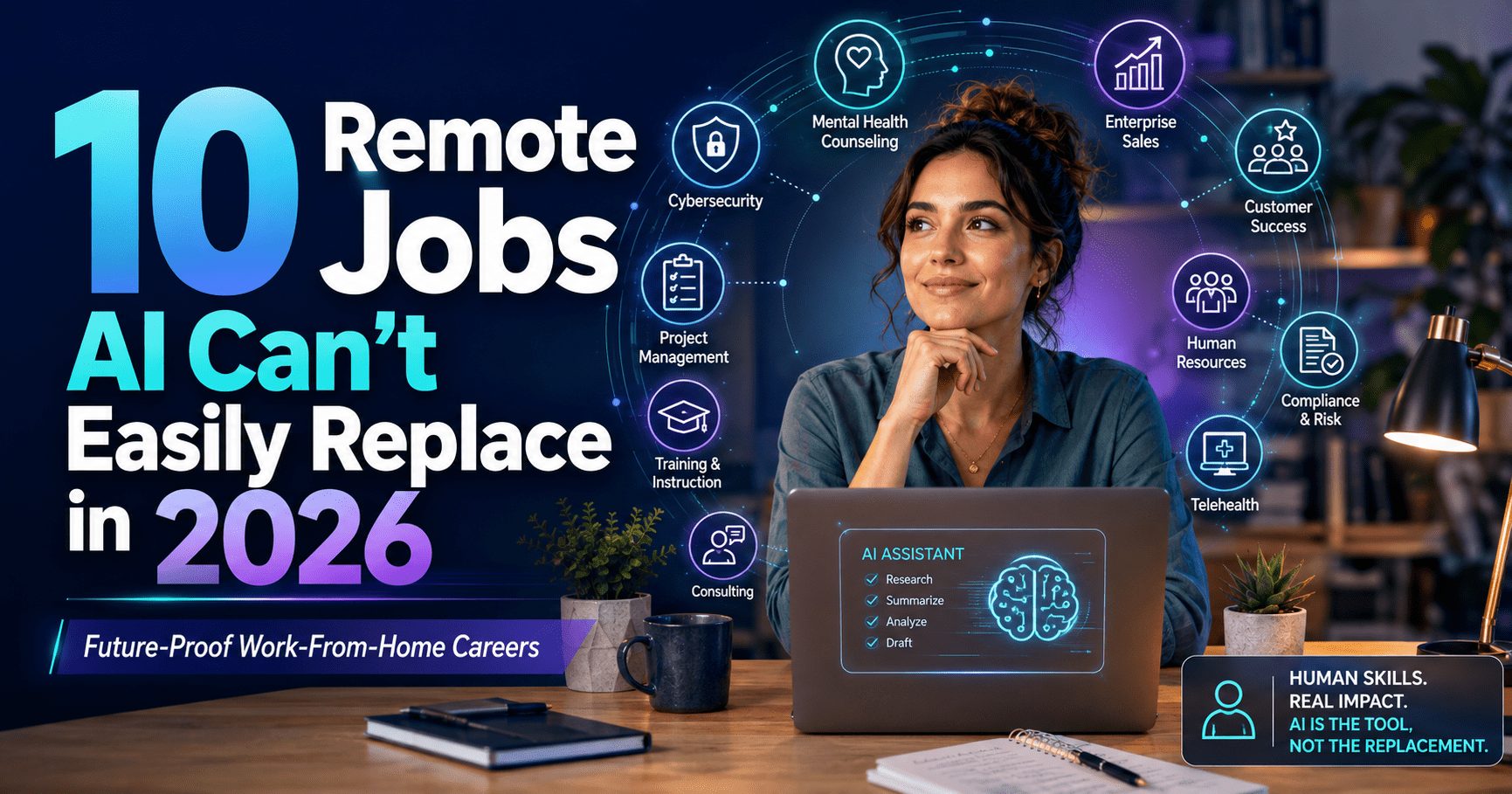


Remote jobs AI cannot easily replace are becoming increasingly important as artificial intelligence transforms the global workplace. AI can now write articles, summarize meetings, create images, analyze spreadsheets, generate computer code, answer customer questions, and automate many routine administrative tasks.
These developments are causing understandable concern among remote workers. Many people are asking whether their jobs will still exist in a few years and which careers offer the best protection against automation.
The reality is more complex than the claim that AI will simply eliminate millions of jobs.
Artificial intelligence is more likely to automate particular tasks within an occupation than replace every person performing that occupation. The International Labour Organization reported in 2025 that about one in four workers worldwide held a job with some level of exposure to generative AI. However, the organization emphasized that job transformation is generally more likely than complete replacement.
This distinction matters.
AI may write a project update, but it cannot easily persuade an angry client to accept a delayed deadline. It may identify unusual activity on a computer network, but an experienced cybersecurity professional must still decide whether the company is under attack and how to respond.
AI may produce a training presentation, but a skilled trainer must determine why employees are underperforming and whether additional training will solve the problem. It may rank sales prospects, but it cannot easily develop trust with several executives and guide them through a complicated purchasing decision.
The safest careers in 2026 are not necessarily jobs that avoid artificial intelligence. They are jobs in which AI serves as a tool while the human professional remains responsible for decisions, relationships, safety, strategy, and results.
In this guide, we explore 10 remote jobs AI cannot easily replace, why these careers remain valuable, what professionals do in each role, which skills employers look for, and how you can prepare for these future-proof work-from-home opportunities.
No occupation is completely protected from technological change. Even jobs that depend heavily on human interaction will use more AI-powered tools in the coming years.
However, certain characteristics make an occupation more resistant to complete automation.
People are more willing to share sensitive information and accept difficult advice when they trust the person providing it.
Trust is central to counseling, healthcare, consulting, human resources, sales, compliance, customer success, and leadership. It develops through credibility, consistency, discretion, empathy, and accountability.
A chatbot may provide information, but it cannot create the same professional relationship that develops when a person knows another human being understands their circumstances and is responsible for helping them.
People do not always communicate their concerns directly.
A client may say a project is “fine” while clearly showing frustration. An employee may describe a workplace complaint indirectly because they fear retaliation. A patient may say they understand medical instructions even though they appear confused.
Professionals must interpret tone, hesitation, behavior, context, and unspoken concerns. AI can analyze words and patterns, but emotional judgment remains difficult to automate reliably.
Businesses need identifiable professionals who can approve decisions, explain their reasoning, communicate with stakeholders, and accept responsibility when something goes wrong.
An AI model cannot independently carry professional liability, appear before a regulator, reassure an affected customer, or take responsibility for a critical decision.
AI performs well when the objective, information, and rules are clearly defined.
Real workplace problems are often unclear. Information may be missing, several explanations may be possible, and each available solution may create new risks.
A professional must decide what information matters, which people should be involved, and which trade-offs are acceptable.
Producing instructions is not the same as motivating people to follow them.
Project managers, trainers, consultants, sales professionals, HR specialists, and customer success managers must persuade people who have different priorities, personalities, and levels of authority.
These roles depend on influence rather than simple information delivery.
A technically correct recommendation may still be harmful, inappropriate, or unrealistic.
Professionals must consider culture, timing, law, reputation, risk, fairness, available resources, and the consequences for real people.
The following careers depend heavily on these qualities, making them some of the strongest examples of remote jobs AI cannot easily replace.
Remote mental health counseling is one of the most human-centered careers available online.
Counselors and therapists meet clients through secure video platforms, assess emotional or behavioral concerns, create treatment plans, provide therapeutic support, document progress, and help people improve their relationships, coping strategies, and mental well-being.
AI-powered mental health tools can already provide general information, mood tracking, journaling prompts, breathing exercises, or basic wellness guidance. These tools may complement professional care, but they cannot easily replace a qualified counselor.
Therapy depends on a relationship built through trust and psychological safety.
Clients may reveal painful experiences gradually. They may avoid certain subjects, contradict themselves, minimize serious concerns, or communicate distress through silence and body language.
A skilled counselor must determine when to listen, when to ask a difficult question, when to challenge a belief, and when to allow the client more time.
The professional must also understand how relationships, trauma, culture, personality, environment, health, work, finances, and family circumstances affect the client’s situation.
Two people experiencing similar symptoms may need completely different forms of support.
Counselors can also have legal and ethical obligations involving confidentiality, informed consent, abuse reporting, recordkeeping, professional boundaries, and immediate safety concerns. These responsibilities require human accountability.
Demand for this profession is also expected to remain strong. The U.S. Bureau of Labor Statistics projects employment for substance abuse, behavioral disorder, and mental health counselors to grow 17% from 2024 to 2034, much faster than the average for all occupations.
Remote counselors may:
Successful remote counselors usually need:
Requirements depend on the position and location.
Many counseling professions require a relevant master’s degree, supervised clinical experience, professional examinations, continuing education, and a state-issued license.
Remote professionals must also understand where they are legally permitted to serve clients. A counselor’s license may not automatically authorize practice in every state or country.
Build expertise in an area that requires sophisticated professional judgment, such as trauma, addiction, marriage and family therapy, behavioral health, grief, adolescent counseling, or workplace mental health.
Use approved technology to improve scheduling, documentation, and educational support, but never rely on unsecured AI tools for confidential client information.
The future-proof counselor will combine technology with genuine human connection.
Cybersecurity incident response is one of the strongest technology careers for people seeking work that AI is unlikely to replace completely.
Incident response specialists investigate suspicious computer activity, contain cyberattacks, preserve digital evidence, coordinate recovery, and help organizations understand how a security failure occurred.
AI is already widely used in cybersecurity. It can process massive quantities of logs, identify unusual behavior, categorize alerts, detect suspicious emails, summarize threat information, and recommend possible actions.
However, automated tools also generate false alarms and incomplete conclusions. Cybercriminals are continually changing their techniques, making human judgment essential.
During a cyberattack, an organization may need to make important decisions before all the facts are available.
An automated system may identify suspicious activity, but a professional must determine:
These decisions involve business continuity, law, reputation, technology, finances, and public trust.
AI may help organize evidence, but it cannot independently accept responsibility for disconnecting a production environment or notifying thousands of customers about a breach.
The employment outlook is particularly strong. BLS projects information security analyst employment to grow 29% from 2024 to 2034, making it one of the fastest-growing computer occupations.
An incident response professional may:
Important technical skills include:
Human skills are equally important:
Depending on the employer and experience level, useful certifications may include:
Learn how AI-based detection tools reach their conclusions, but do not depend on them blindly.
Develop expertise in cloud incident response, threat hunting, digital forensics, identity attacks, ransomware response, and security communication.
AI may generate the alert. The human responder determines what the alert means and what the organization must do next.
Project management is another leading example of remote jobs AI cannot easily replace because projects depend on successful human coordination.
A remote project manager helps a team achieve a specific goal within agreed limits involving time, money, resources, quality, risk, and scope.
Projects may involve software development, cybersecurity, healthcare, marketing, construction planning, product launches, cloud migration, business transformation, or organizational change.
AI can create schedules, draft project plans, summarize meetings, identify dependencies, prepare reports, and recommend task assignments.
These capabilities will automate administrative project-management work, but they will not eliminate the need for project leadership.
Projects rarely fail because nobody could create a checklist.
They fail because:
A project manager must resolve these human and organizational problems.
For example, the customer may demand additional features without accepting a longer deadline. The technical team may insist that the deadline is impossible. Senior leadership may refuse to increase the budget.
An AI tool can summarize these positions. A human project manager must negotiate an acceptable decision.
BLS projects employment for project management specialists to grow 6% from 2024 to 2034, faster than the average for all occupations.
Project managers frequently:
Employers often look for:
Knowledge of the project’s industry can be extremely valuable.
A cybersecurity project manager who understands security controls may be more competitive than a general project manager. The same applies to healthcare, cloud computing, finance, engineering, and government projects.
Common project-management credentials include:
Move beyond updating spreadsheets and sending meeting invitations.
Use AI to automate routine reporting, meeting summaries, scheduling, and documentation. Invest your time in stakeholder relationships, negotiation, decision-making, risk management, and leadership.
A coordinator who only updates task records may be vulnerable to automation. A project manager who resolves conflict and guides high-value decisions will remain important.
Artificial intelligence will automate many routine sales activities.
AI tools can identify potential customers, research companies, write outreach messages, update customer records, score leads, answer common questions, and recommend follow-up actions.
However, complex business-to-business sales depend on relationships, negotiation, trust, and strategic decision-making.
A remote enterprise sales professional helps organizations purchase expensive or important products and services, such as cybersecurity platforms, cloud technology, financial systems, healthcare software, logistics solutions, consulting services, or large software subscriptions.
These purchases may involve several months of discussions and multiple decision-makers.
A company does not purchase a major service simply because a chatbot lists attractive product features.
Executives want confidence that the provider understands their organization, can manage implementation risk, and will remain accountable when problems occur.
An enterprise salesperson must identify the priorities of several stakeholders.
For example:
The salesperson must build support among all these groups.
Negotiations may involve pricing, service levels, implementation dates, contract length, product features, legal conditions, training, data protection, and payment schedules.
AI can suggest negotiation options, but a human professional must decide which compromises will protect the relationship and close the agreement.
Sales-management employment is projected to grow 5% from 2024 to 2034, according to BLS.
Enterprise sales professionals often:
Important skills include:
Avoid limiting yourself to repetitive, high-volume outreach.
Develop expertise in a complex industry or product category where buyers need guidance. Learn how the customer’s organization makes decisions and what risks each stakeholder is trying to avoid.
Use AI to research prospects, organize account information, prepare questions, and draft follow-ups.
Then use your human skills to establish trust and guide the purchasing process.
Customer success and basic customer service are not the same.
Traditional customer service often focuses on answering questions, processing refunds, resetting passwords, or explaining policies. Many routine support tasks can be automated with chatbots and self-service knowledge bases.
Customer success is more strategic.
A remote customer success manager helps clients achieve long-term results from a product or service. The professional may guide onboarding, improve product adoption, reduce cancellation risk, coordinate technical support, manage renewals, and help customers accomplish specific business goals.
A customer may stop using a product for reasons that are not immediately visible in the data.
Perhaps:
AI may detect reduced usage, but a customer success manager must discover the real cause and rebuild the relationship.
Customer success also requires internal influence. The manager may need to persuade product developers to fix a problem, encourage a support team to prioritize an issue, or work with sales representatives to restructure a renewal.
AI can predict that a client might cancel. It cannot easily conduct the sensitive conversations needed to restore confidence.
Customer success managers may:
Employers value:
Technical customer success roles may require additional knowledge of software integrations, analytics, cloud systems, security, or data migration.
Do not build your career around answering questions that a help center can resolve.
Learn how customers measure success and how your employer’s product affects revenue, productivity, risk, or customer satisfaction.
The future-proof customer success professional becomes a trusted adviser and protects important client relationships.
The most valuable remote jobs AI cannot easily replace are jobs where technology provides information but a human remains responsible for relationships and outcomes. Customer success clearly fits that description.
Artificial intelligence is already changing human resources.
AI can screen applications, draft job descriptions, schedule interviews, prepare policy summaries, answer common benefit questions, and organize employee records.
These tasks may reduce some administrative HR work, but human resources also involves sensitive decisions about real people.
Remote HR and employee relations specialists help organizations manage hiring, workplace conflict, performance, discipline, complaints, accommodations, culture, and organizational change.
Employee situations are rarely as simple as they initially appear.
Suppose an employee claims that a manager is treating them unfairly. The HR specialist must:
An AI tool may summarize the evidence, but it cannot safely assume complete responsibility for the outcome.
Employees may also be reluctant to share sensitive concerns with an automated system. Complaints involving harassment, discrimination, family problems, health needs, intimidation, or workplace retaliation require discretion and empathy.
BLS projects employment for human resources specialists to grow 6% from 2024 to 2034, with about 81,800 openings projected each year on average.
HR and employee relations professionals may:
Important skills include:
Employers may prefer degrees in:
Useful certifications may include:
Move toward HR responsibilities that require judgment.
Areas such as employee relations, workplace investigations, organizational development, labor relations, compensation strategy, and change management are generally more resistant to automation than routine scheduling or record maintenance.
The HR specialist who resolves difficult workplace problems will remain more valuable than one whose work is entirely administrative.
Organizations must comply with laws, regulations, contracts, professional standards, and internal policies.
Failure to comply can lead to fines, lawsuits, security breaches, damaged reputations, business restrictions, or harm to customers.
Remote compliance and risk specialists identify requirements, evaluate weaknesses, conduct assessments, investigate concerns, prepare policies, and recommend corrective action.
These professionals can work in healthcare, finance, insurance, cybersecurity, technology, manufacturing, education, government contracting, and many other industries.
AI can search regulations and compare documents quickly.
However, compliance rarely involves applying one clear rule to one simple situation.
Regulations may:
A compliance professional must determine how the rules apply to the organization’s systems, products, customers, contracts, and processes.
The technically safest option may be extremely expensive or operationally impossible. The specialist must help leadership understand the risks and select a defensible solution.
The work may also require challenging senior decision-makers. A compliance specialist may need to recommend delaying a profitable product because required controls are missing.
BLS states that compliance officers help organizations meet legal and regulatory requirements. The occupation is projected to have about 33,300 openings per year, on average, from 2024 to 2034.
Compliance and risk specialists may:
Career options include:
Strong candidates usually possess:
Choose an industry and develop deep knowledge of its rules, technology, and operating practices.
Use AI for research, document comparison, evidence organization, and policy drafting, but verify every important conclusion.
AI can identify a possible risk. The human professional must determine how serious the risk is and what the organization should do about it.
Companies must continually train employees on technology, procedures, customer service, leadership, safety, cybersecurity, and regulatory requirements.
AI can create training outlines, quizzes, presentations, videos, simulations, and written materials.
This will reduce the amount of time required to produce basic training content. However, successful employee development involves much more than content creation.
A remote training and development specialist identifies performance needs, designs learning programs, facilitates virtual sessions, coaches employees, evaluates outcomes, and helps organizations change behavior.
Employees may underperform for many different reasons.
They may:
A training specialist must determine whether training is actually the solution.
If the real problem is poor management or an inefficient system, another online course will not correct it.
Live instruction also requires flexibility. A trainer must recognize confusion, low engagement, defensiveness, frustration, or disagreement and adjust the session immediately.
Different audiences may need different approaches. Senior managers, technical employees, new hires, customer-service representatives, and international teams may not respond to the same materials.
BLS projects training and development specialist employment to grow 11% from 2024 to 2034, much faster than the average for all occupations.
Training specialists may:
Employers often look for:
Do not define your value by your ability to make slides. AI can create presentations quickly.
Become skilled at diagnosing performance problems, designing learning strategies, facilitating difficult discussions, coaching managers, and measuring behavioral change.
Use AI to create drafts and exercises, but remain responsible for the learning experience and its results.
Management consultants help organizations solve difficult business problems.
They may analyze operations, reduce costs, improve customer experience, redesign processes, support technology adoption, develop business strategies, or manage organizational change.
Artificial intelligence can analyze datasets, summarize interviews, compare performance measures, create charts, and prepare presentation drafts.
These capabilities will change consulting, but they will not eliminate the need for trusted advisers.
Organizations do not always hire consultants because information is unavailable.
They hire consultants because they need:
A consultant may discover that the problem described by leadership is not the organization’s real problem.
For example, leaders may believe sales are falling because marketing is ineffective. The actual cause may be poor customer retention, product-quality issues, confusing pricing, weak sales management, or an outdated purchasing process.
Identifying the true cause requires data analysis, interviews, observation, political awareness, and the ability to ask uncomfortable questions.
Implementation is even more human.
A recommendation may be logically correct but fail because employees do not trust leadership, departments protect their authority, or executives disagree about priorities.
BLS projects management analyst employment to grow 9% from 2024 to 2034, much faster than the average for all occupations.
Consultants may:
Consultants become more competitive by developing expertise in:
Successful consultants require:
Generic information is becoming less valuable because AI can generate it quickly.
Specialized judgment, credibility, implementation experience, and executive communication are becoming more valuable.
A consultant who only produces documents may face significant automation. A consultant who helps leadership make and implement difficult decisions remains difficult to replace.
Not every nursing position can be performed remotely, but telehealth nursing and care coordination provide important work-from-home opportunities for qualified healthcare professionals.
Remote nurses may assess symptoms, provide education, monitor chronic conditions, coordinate appointments, support medication adherence, review patient information, and help patients determine when they need urgent or in-person care.
AI can assist with scheduling, documentation, symptom screening, translation, monitoring, and clinical decision support.
However, patient care involves uncertainty, communication, safety, ethics, and professional responsibility.
Patients do not always describe symptoms clearly.
They may:
A remote nurse listens for both information and urgency.
The same symptom may require different advice depending on the patient’s age, medications, pregnancy status, recent procedures, chronic conditions, medical history, or access to care.
Nurses also help patients overcome practical barriers.
A person may understand that medication is important but avoid taking it because of side effects, cost, fear, cultural beliefs, or a complicated routine. The care coordinator must identify the real barrier and help find a safe solution.
BLS projects registered-nurse employment to grow 5% from 2024 to 2034, with approximately 189,100 openings projected each year, on average, during that period.
Telehealth nurses and care coordinators may:
Most remote nursing positions require:
Employers may prefer experience in emergency care, primary care, behavioral health, case management, chronic-disease management, insurance, or utilization review.
Develop excellent remote-assessment and patient-education skills.
Learn electronic health records, remote monitoring technology, secure communication systems, and clinical decision-support platforms.
AI may identify relevant patient information. The nurse must determine how to communicate it, when to escalate care, and how to protect the patient.
The ten careers above are not the only possibilities.
Other human-centered remote occupations may include:
The level of automation risk depends on the actual responsibilities of each position.
A job title alone does not guarantee security. A product manager who only organizes tickets may face more automation than one who conducts customer research, negotiates priorities, and makes important strategic decisions.
Some remote occupations are more exposed because they involve predictable, repeatable, digital tasks.
Examples may include:
This does not mean every worker in these fields will immediately lose employment.
It means AI may allow fewer people to produce a much larger volume of work. Employers may redesign these jobs, combine responsibilities, or expect workers to manage automated systems.
Workers in highly exposed positions should move toward responsibilities involving:
For example, a general content writer could specialize in technical or regulated industries that require expert interviews and source verification.
A customer-service representative could advance into customer success, escalation management, or technical account management.
A data-entry worker could develop skills in data quality, auditing, governance, business analysis, or system administration.
Finding remote jobs AI cannot easily replace is only the first step. You must also make your individual skills difficult to automate.
AI can generate general information about almost any subject.
Employers still need professionals who understand how an industry operates in practice.
Choose an area such as:
Learn its terminology, regulations, customers, technologies, risks, and business processes.
Remote professionals must communicate clearly without relying on physical presence.
Practice:
As AI-generated content becomes more common, the ability to explain what matters will become more valuable.
Routine work is easy to automate. Complicated human situations are not.
Gain experience with:
These experiences develop professional judgment.
Avoiding AI entirely is not a future-proof strategy.
Use appropriate tools to:
Always verify important output and protect private, regulated, or confidential information.
Do not describe yourself only by listing responsibilities.
Show what improved because of your work.
Examples include:
Results show that you can create value beyond completing routine tasks.
Workers who only transfer information between systems may face greater automation risk.
Move toward roles where you:
Accountability creates professional value.
Trust and reputation are difficult to automate.
Develop relationships through:
Companies often prefer trusted recommendations when filling sensitive or important positions.
Remote-job scams frequently target people who want to work from home.
Warning signs may include:
Research the organization independently before providing personal information.
Look for the opening on the employer’s official career page and verify the recruiter’s identity.
Legitimate skilled remote jobs usually involve a careful selection process because employees may handle clients, systems, money, health information, workplace investigations, or regulated data.
Instead of searching only for “work-from-home jobs,” use specific job titles.
Useful searches include:
Add your industry or qualification to improve the results.
For example:
No job is guaranteed complete protection from technological change.
However, jobs involving emotional intelligence, trust, complex negotiation, professional responsibility, crisis management, leadership, and unpredictable decision-making are more difficult to automate completely.
Examples include therapists, cybersecurity responders, project managers, nurses, consultants, compliance specialists, employee-relations professionals, and enterprise salespeople.
Some of the best remote jobs AI cannot easily replace include:
These careers remain human-centered even when AI is used to automate certain tasks.
No occupation is completely safe from technological change.
The goal is to choose a career where AI is more likely to assist a professional than eliminate the entire role.
Jobs involving relationships, accountability, judgment, and specialized knowledge are generally more resilient.
AI is likely to automate many basic customer-service tasks, especially repetitive questions with predictable answers.
Complex roles involving escalations, technical coordination, account strategy, customer retention, emotional conversations, and high-value relationships will continue to require people.
AI will automate meeting summaries, schedules, documentation, status reports, and task tracking.
It is less capable of resolving conflict, negotiating priorities, motivating teams, understanding organizational politics, and taking responsibility for high-risk decisions.
Project managers should strengthen these human-centered skills.
Cybersecurity, enterprise sales, project management, consulting, compliance leadership, technical customer success, and some telehealth roles may offer strong earning potential.
Pay depends on experience, qualifications, industry, employer, and location.
Not always.
Counseling, nursing, and certain regulated professions generally require formal education and licensing.
Cybersecurity, sales, customer success, project coordination, and training may offer alternative entry paths through certifications, experience, portfolios, or demonstrated results.
Choose one target career and study its requirements.
Build practical skills, earn a relevant entry-level certification when helpful, complete projects, improve communication, and gain experience solving real problems.
Learn to use AI tools responsibly, but do not build your value entirely around tasks AI can perform easily.
The future of remote work will not be determined by humans attempting to outperform machines at repetitive digital tasks.
Successful professionals will learn how to use artificial intelligence while strengthening the abilities that technology cannot easily reproduce.
The 10 remote jobs AI cannot easily replace in 2026 are:
These professions will still use AI.
Counselors may use technology to reduce administrative work. Cybersecurity professionals may use AI to process security alerts. Project managers may automate reports. Trainers may generate learning materials. Consultants may analyze larger amounts of data. Nurses may use clinical decision-support platforms.
However, the final value comes from the person who understands the situation, evaluates the risks, communicates with the people involved, and accepts responsibility for the outcome.
For people searching for remote jobs AI cannot easily replace, the best strategy is to combine industry knowledge with communication, empathy, leadership, decision-making, and technological competence.
Learn how to use AI, but do not try to become a human version of a chatbot.
Become the professional who knows when AI is wrong, what its output means, how a decision affects real people, and what should happen next.
That is how you build a future-proof remote career in 2026 and beyond.