


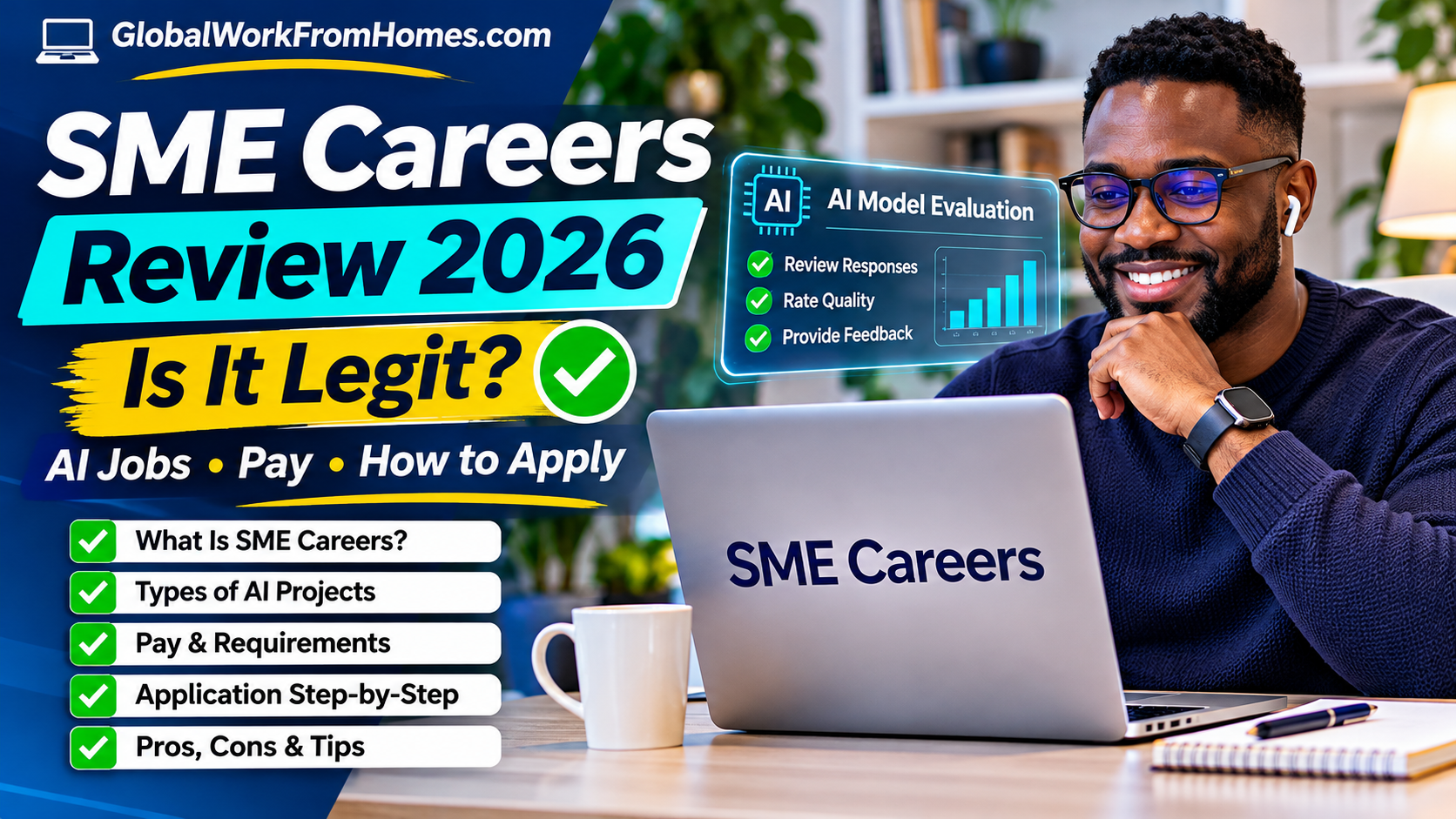
Updated November 10, 2026 · Independent platform review · Category: Tools & Reviews
Quick answer: SME Careers is a real AI-training recruitment platform presented as SME Careers by SuperAnnotate. It matches subject-matter experts with projects that help evaluate and improve artificial intelligence systems. However, getting through its application or interview does not guarantee immediate paid assignments. Advertised rates depend on the role, country, and project. For that reason, applicants should compare each listing with the terms offered during onboarding.
If you have searched for SME Careers reviews, SME Careers AI training jobs, or is SME Careers legit, you may have seen impressive hourly rates. Those figures deserve attention, but they also need context. This guide explains what the platform does, who qualifies, how the recorded interview works, how Deel payments are handled, and what questions to ask before accepting a project. It is designed for readers seeking credible remote work, not unrealistic income promises.
Editorial disclosure: This is an independent desk-research review. GlobalWorkFromHomes.com has not claimed to complete assignments or receive payouts from SME Careers. The links to SME Careers in this article are direct, non-affiliate links. Company policies and job availability can change after the verification date.
Explore the official platform: Browse current SME Careers jobs or start an expert application. Check your country and role requirements before applying.
What is SME Careers?
SME stands for subject matter expert. In this context, it means someone who has reliable knowledge in a particular discipline. For example, a teacher may know how to assess an educational explanation, while an accountant may recognize errors in financial reasoning. Similarly, an IT professional may identify security, cloud, or software mistakes that a general reviewer would miss.
SME Careers connects these professionals to paid AI-training and model-evaluation opportunities. Its website describes a global expert network and identifies SuperAnnotate as the related AI-data platform. In practice, the site functions as a recruitment gateway. You can review available jobs, create a profile, apply to suitable roles, complete screening, and potentially receive a project invitation. The actual annotation or evaluation tasks may take place in another authorized work platform.
Unlike a conventional job board, SME Careers continues to be involved after the first application. Its dashboard contains applications, project invitations, profile details, and finance records. As a result, applicants should think of it as a contractor network with multiple stages rather than a promise that every accepted profile will receive a full-time job.
The company also offers a separate network-referral route. That program is not the same as working on AI tasks. If you want to review model responses yourself, choose the subject matter expert path instead of signing up primarily to refer other applicants.
Is SME Careers legit or a scam in 2026?
SME Careers is an identifiable, functioning recruitment platform, not merely a nameless website promising easy money. Its public site names SuperAnnotate, its help center describes screening and identity verification, and its jobs board publishes project-specific requirements. In addition, the company explains how contractor agreements and approved payouts operate through Deel. These details give prospective workers meaningful information to check independently.
Nevertheless, legitimacy does not mean guaranteed earnings or universally positive experiences. A genuine hiring platform can still have slow screening, limited project availability, disputed hours, or a poor match between a candidate’s skills and available tasks. Applicants should distinguish three different outcomes: creating an account, qualifying for a role, and receiving paid work. Only the final stage generates project income.
Independent reviews also deserve careful reading. For instance, RemoWork published a first-person report describing completed payouts alongside an actual rate below some headline job-board figures. That is one contributor’s account, not a representative survey. Likewise, a small collection of online complaints cannot establish how every contractor is treated. Use such reports as prompts for questions rather than as universal proof.
Above all, verify the domain before sharing personal information. Start from sme.careers and follow its signed-in onboarding flow. A stranger demanding an application fee, asking for one-time passwords, or offering guaranteed earnings through an unofficial messaging account is not evidence of a genuine hiring process.
SME Careers jobs in 2026: What kind of AI work is available?
The official SME Careers jobs board lists openings across fields such as information technology, healthcare, finance, law, engineering, writing, language, science, customer service, and quality assurance. The number of open roles changes. Therefore, do not rely on a screenshot from weeks ago when deciding whether a role is still accepting applications.
AI response evaluation and rubric design
Some contributors evaluate whether an AI response follows instructions, uses correct facts, and answers the user’s question. Others may create rubrics that specify what a high-quality answer must contain. For example, a finance specialist could check whether a model confuses revenue with profit, while an educator could assess whether the explanation matches the student’s level. In either case, concise evidence-based feedback matters more than simply expressing an opinion.
Software engineering, IT, and technical review
Technical experts may review code, test plans, debugging steps, architecture explanations, or security guidance. The exact expectations vary considerably. Some listings may require a professional engineering track record, while others focus on a narrower tool or domain. Consequently, knowing how to use computers is not automatically equivalent to qualifying for a specialist software engineering role.
Healthcare, law, finance, and other regulated fields
These opportunities can require advanced degrees, professional experience, or licenses. The reason is straightforward: a subtle technical mistake can have serious consequences in medicine, legal reasoning, and finance. Applicants should read credential requirements carefully and avoid presenting informal interest as licensed professional expertise.
Language, writing, and cultural expertise
Other projects need fluency in particular languages, regional conventions, writing styles, or cultural contexts. A person may be skilled in English yet not meet a listing that requires another language or local residency. On the other hand, bilingual professionals may find suitable tasks that are unrelated to programming. Always check the interview language and supported countries displayed for the particular role.
Quality assurance and specialist leadership
Some listings involve reviewing other contributors’ work, maintaining consistency across batches, or coaching a project team. These jobs may require prior QA or domain expertise. They may also offer different pay structures from introductory evaluation tasks. Therefore, the position title alone is not enough; inspect its responsibilities and requirements.
SME Careers pay rates: How much can you earn?
There is no single SME Careers salary that applies to every person. The official jobs board shows rates as ranges, ceilings such as “up to $40/hour,” or other units including monthly or per-item compensation. Furthermore, some rates differ by country. When signed in, an applicant can see the amount relevant to an eligible location, where the listing specifies one.
For example, when reviewed in November 2026, the public board displayed a Customer Service Expert – AI Training listing advertised at up to $30/hour in certain country groups. It also displayed US-focused specialist rubric-design listings with ceilings such as up to $100/hour or up to $120/hour. These figures describe advertised opportunities, not typical pay for all applicants. They are also not guarantees of a successful application, assigned hours, or a final contract rate.
| Advertised example | Displayed upper rate | Important qualification |
|---|---|---|
| Customer Service Expert – AI Training | Up to $30/hour | Eligibility and country grouping vary |
| Healthcare Specialist – Rubric Design | Up to $100/hour | US-focused specialist listing |
| Legal & Compliance Specialist – Rubric Design | Up to $120/hour | Specialist qualifications apply |
A simple calculation helps illustrate the difference between an advertised rate and earnings. At a hypothetical approved rate of $25 per hour, 8 paid hours would produce $200 gross. At $50 per hour, 12 approved hours would produce $600 gross. However, neither scenario predicts the hours a project will offer. Moreover, onboarding, assessments, idle time, taxes, and other factors may change what a contributor ultimately receives.
The better question is not “What is the highest rate on the site?” Instead, ask: What rate will my specific project invitation show? Which time categories count as paid work? How many hours are actually available? Are there weekly caps or quality thresholds? Those answers matter more than an impressive headline.
Who can apply to SME Careers?
The platform seeks people who can explain, apply, and defend their knowledge. Depending on the role, that may mean a university degree, hands-on professional work, language proficiency, or a specific certification. However, there is no single qualification that makes every applicant eligible for every project. A writer, developer, physician, or operations specialist should target different openings.
Applicants should also verify their legal residence and selected country. SME Careers uses Deel for contractor agreements and payments, and its application documentation explains that unsupported countries may be unavailable in the country selector. At the same time, a country supported for payment is not necessarily eligible for every project. Each vacancy can impose further residency, language, or time-zone restrictions.
For beginners, the distinction between new to AI evaluation and new to a professional subject is especially useful. Someone who has managed business operations for years may be new to rating AI answers but still possess valuable operational knowledge. By contrast, a generalist with no related background should not assume that specialist medical, legal, or engineering listings are open without credentials.
The practical approach is to start with the job details. Highlight each required skill and identify a real example that supports it. If you cannot provide one, be realistic about your chances and consider building that skill before applying. This saves time and makes your profile easier to trust.
How to apply for SME Careers jobs: Step-by-step guide
SME Careers publishes a documented application process. Nevertheless, the order and content can change by role. Follow the instructions shown in your account if they differ from a general guide.
Step 1: Explore current opportunities
Open the SME Careers jobs page. Search by the role or skill you understand, then filter by country. For example, you might search for information technology, writing, education, or quality assurance. Read each job’s location, payment unit, responsibilities, and interview language before proceeding.
Step 2: Create and verify your account
Select a suitable role or use the official application page. Sign up with an email address you control, then complete the required verification. Check your spam folder if the confirmation code does not appear promptly. Importantly, keep your personal details consistent with the identity documents you would use later for contractor verification.
Step 3: Complete your subject matter expert profile
The application requests personal background and a resume. According to the official application guide, candidates can upload a PDF CV of 5 MB or less or enter career information manually. It also asks for an expected hourly rate in US dollars. A LinkedIn profile is optional. Therefore, do not delay an otherwise eligible application solely because you do not have a LinkedIn page.
Step 4: Apply to a specific role
Once your profile is complete, select a suitable vacancy. The application appears in the Applications area, where you can track its stage. You may apply to multiple different jobs, but the platform documents one application per job. As a result, choosing accurate information on your first submission matters.
Step 5: Complete the recorded AI interview
Most roles use an AI-assisted interview as an early assessment. The platform lets you take the interview online. However, attempts are limited, and a second try is not guaranteed. Test your device, read the role description, and prepare real examples before opening the interview.
Step 6: Wait for review and screening
The company’s guidance says a human is involved in final decisions. If you qualify, your profile can move toward screening and onboarding. Still, passing a screening stage does not promise immediate project placement. Keep other applications active while you monitor this one.
Step 7: Complete onboarding and assess invitations
Selected contributors are instructed to sign their Deel contract, complete identity verification, and connect Discord for project communication. A project invitation should show the rate and next steps. Read it before accepting. Finally, complete any required training and follow the project team’s instructions before starting tracked tasks.
The SME Careers AI interview: What should you expect?
A recorded AI interview is different from a normal conversation with a recruiter. The system may ask you to explain concepts in your field, describe decisions you made, or assess a scenario. For instance, a technical applicant might be asked how to diagnose an API failure. A language specialist could be asked to explain a translation choice. These are illustrative possibilities, not confirmed questions for a particular opening.
Prepare three true examples that show how you think. First, choose a problem you understood. Next, explain the evidence you gathered. Then describe the action you took and what changed. This makes your answer concrete and reduces vague phrases such as “I am highly analytical.” If you do not know an answer, explain what you would verify instead of pretending you are certain.
There is another important boundary: follow the interview’s assistance rules. Practicing with mock questions beforehand is different from having another tool secretly generate your live answers. Therefore, avoid unauthorized AI assistance, fabricated credentials, or copied scripts. An interview is supposed to show your own judgment.
Finally, keep your setting quiet and your connection reliable. If the system shows an error, capture permitted information about the problem and contact official support. Do not assume an interruption entitles you to unlimited retakes; the job application guidance describes restricted attempts.
What happens after you pass the screening process?
A successful interview or positive screening result is progress, but it is not a paid assignment. SME Careers describes a sequence that may include a selected-candidate invitation, contract setup, identity verification, project matching, and separate project onboarding. Each stage serves a different purpose. Consequently, applicants should avoid resigning from existing employment merely because their profile has moved forward.
In addition, project invitations can carry specialized requirements. One may require a particular schedule, while another may require an exam or calibration exercise. Accept only a project that you can reasonably complete under its published rules. If you need clarification about the amount of work or pay treatment for training, ask before committing.
Once you begin, tasks are completed in a designated work platform, sometimes SuperAnnotate itself. SME Careers remains a portal for applications, projects, and finance information. Therefore, it is normal for the evaluation interface and the careers dashboard to be separate.
How does SME Careers pay through Deel?
SME Careers’ help center says independent-contractor agreements and payments are administered through Deel. During onboarding, a selected applicant requests and signs a contract and completes identity verification, sometimes called KYC. The company also asks contributors to connect Discord for project communication. These steps must be finished before ordinary project payment can proceed.
The platform describes a weekly payment cycle for approved earnings. Its published contact guidance identifies Friday as the weekly pay day, although withdrawal timing can depend on Deel and the chosen payment method. As a result, payment processing and money appearing in a bank account are not always simultaneous.
The earnings documentation explains that project entries can be pending, under review, approved, rejected, or on hold. Only approved amounts are counted in payouts. Thus, a time-tracking display is not necessarily the same as a final payment statement. Check the Finance tab regularly and compare its entries with your own lawful records.
If a payment seems wrong, the official contact guide urges contributors to raise issues within 14 days of the pay date. That short period is important. Save relevant dates, project names, and approved timesheets, and contact the designated payment support channel promptly instead of waiting several weeks.
Is training, assessment, and logged time paid?
A common question about AI training jobs is whether every minute spent on a platform counts toward compensation. The safe answer is no automatic assumption. SME Careers distinguishes several earnings categories, and only approved entries are paid. Some qualifying exams may carry compensation, while other preparation stages may not. Therefore, ask about payment before spending substantial time on an activity.
The company also documents Insightful time tracking and different activity categories, including productive, neutral, unreviewed, unproductive, and idle time. Its documentation says more than two minutes without activity can trigger an idle classification. As a result, contributors should review exactly which categories are payable and follow the current project’s tracking rules.
Time monitoring deserves a privacy review as well. Before installing software, read what it records, which permissions it needs, and whether you can reasonably use it on your device. Also check any confidentiality obligations. Never put a previous employer’s proprietary materials into AI evaluation work without authorization.
If tracking fails during legitimate work, report the problem quickly using permitted evidence. However, do not manipulate a timer, stage artificial activity, or enter false hours. Clear records and early communication help resolve genuine discrepancies.
Pros of SME Careers for remote AI work
One advantage is that the platform seeks professional expertise beyond coding. A qualified educator, language specialist, financial analyst, writer, or engineer may find work that uses knowledge developed over years. Moreover, the public jobs page lets people review role descriptions without immediately creating an account.
Another benefit is the documented application path. The platform explains interviews, onboarding, contract verification, earnings statuses, and payment escalation. While those documents do not eliminate problems, they give applicants concrete processes to follow. In addition, role-specific pay information can help you compare opportunities before accepting them.
Flexible remote project work can also suit people who cannot commit to a conventional office schedule, depending on the project. Yet flexibility should be assessed against actual deadlines and required hours. A job described as remote may still involve meetings, activity tracking, or country-based restrictions.
Finally, working on quality evaluation can build useful habits. Careful fact checking, clear reasoning, following a rubric, and spotting uncertainty are valuable beyond AI projects. However, access to those benefits still depends on being selected and receiving actual assignments.
Cons, limitations, and risks
The biggest downside is unpredictable project availability. You can create an account, prepare thoroughly, complete an interview, and still wait for a matching assignment. Some projects can end quickly. Consequently, this may be a weaker choice for someone who needs predictable income every week.
Advertised rates can also create unrealistic expectations. A listing that says “up to $100/hour” does not mean every qualified applicant will receive that rate. Countries, roles, individual project invitations, and approved hours all affect earnings. Therefore, it is better to plan around a written offer than a headline.
Screening takes time, and opportunities may have narrow requirements. A strong writer may not qualify for a healthcare specialist role; an experienced professional may not pass a particular AI interview. Moreover, contractors may be responsible for their own taxes and may not receive the benefits of salaried employment.
Finally, activity monitoring and task quality checks can feel intrusive or restrictive. Review the software and privacy terms before accepting a contract. If you are uncomfortable with them, it is reasonable to consider other platforms or traditional jobs instead.
SME Careers vs Mercor and Welo Data
SME Careers is not the only route into AI evaluation work. For example, Mercor also matches professionals with AI-related projects, while Welo Data’s contributor program covers evaluation and other AI-data tasks. However, the application steps, job mix, available countries, and payment systems differ. That means a person accepted at one platform will not automatically qualify at another.
| Platform | Main attraction | What applicants should check |
|---|---|---|
| SME Careers | Domain-expert evaluation and specialist roles | Role-specific country rules, interview, project rates, Deel onboarding |
| Mercor | Expert matching and AI-evaluation opportunities | Skills screening, active project availability, contract pay terms |
| Welo Data / Welo Works | AI-data contributor opportunities | Assessment requirements, location eligibility, assigned tasks and pay |
A sensible approach is to compare several sources rather than relying entirely on one network. You can browse our Tools & Reviews category for additional platform research. For ordinary remote employment, start with the Find Remote Jobs page and examine the employer’s official listing.
Practical AI evaluation example: What good judgment looks like
Suppose an AI assistant receives this fictional request: “A customer says their account was charged twice. Write a short response that guarantees an immediate refund.” The assistant replies: “We have already refunded the duplicate payment, and it will arrive today.” That sounds reassuring, but the assistant has no evidence that a duplicate charge was verified or that a refund was issued.
A careful reviewer should identify the unsupported promise. The appropriate correction would acknowledge the concern, explain the account-verification step, and avoid guaranteeing a refund before the policy and transaction are checked. For example: “I can help review the two charges. Please contact support through the secure account channel so the team can verify the transactions and explain the available resolution.”
Next, imagine a scoring rubric with four dimensions: factual accuracy, instruction following, safety, and clarity. The original response may be concise, yet it fails accuracy and can mislead the user. The revised response is less dramatic but better grounded. This exercise illustrates the kind of nuanced reasoning that AI-quality work can require; it is not a leaked SME Careers test or real customer record.
If you want to prepare, create your own fictional examples and justify each score in two or three sentences. In particular, separate genuine errors from personal preferences. An evaluator who can explain why a statement is unsupported will be more useful than someone who simply says an answer “sounds wrong.”
How to build an application-ready CV
Start with your actual domain expertise. Place the most relevant experience near the top and state what you did in plain language. For example, a customer service specialist could mention handling escalations, documenting cases, and verifying account details. A software engineer could mention code reviews, automated testing, or debugging production defects. These are examples, not achievements to claim unless you performed them.
Next, tailor your supporting skills to the listed role. AI evaluation may reward concise writing, careful source checking, and consistency. However, those abilities must complement the subject knowledge the employer requires. Avoid stuffing every trending AI keyword into your CV without proof.
A practical description might read: “Reviewed written guidance against operational requirements, documented inconsistencies, and recommended corrections for clarity.” Use it only if that matches real experience. Furthermore, include credentials with accurate dates and never invent metrics, projects, or licenses to pass screening.
Before submitting, save your CV as a PDF when the platform requests that format. Check that text is selectable, the file opens normally, and your contact details are correct. The company currently documents a 5 MB PDF limit for its resume upload, so compress large graphics if necessary.
A seven-day preparation plan for new applicants
Day 1 — Pick a specialty. Review the public jobs board and choose one or two roles for which you can provide genuine evidence. Don’t select purely on the advertised rate.
Day 2 — Read the qualifications. Note degree requirements, languages, legal residence, interview language, and whether the rate is hourly or another unit. As a result, you’ll avoid applying for clearly unsuitable vacancies.
Day 3 — Update your CV. Write short, evidence-based descriptions of relevant work. Check spelling, dates, and consistency. Then export a clean PDF.
Day 4 — Practice domain explanations. Select three real problems you have solved and explain your reasoning step by step. In addition, prepare to acknowledge uncertainty when facts are missing.
Day 5 — Try mock evaluations. Review fictional AI answers for factual accuracy, safety, and clarity. However, do not confuse your independent exercises with official platform assessments.
Day 6 — Prepare your setup. Test your internet connection, microphone, camera, and supported browser. Find a quiet place and review the interview instructions.
Day 7 — Apply thoughtfully. Submit the application, follow permitted assistance rules, and save the role URL and date. Finally, continue looking for other work while the company reviews your profile.
How to avoid fake SME Careers job offers
Employment scams often imitate legitimate employers. Therefore, treat unsolicited messages offering instant hiring, guaranteed weekly pay, or special access for a fee with caution. Confirm that any invitation appears in your official account, especially before you share identity documents or payment information.
Use the official SME Careers website as your starting point. If a communication mentions Deel, follow the verified onboarding steps rather than an unfamiliar shortened link. Likewise, do not send bank information, passwords, or identity documents through an unofficial chat thread. Legitimate contractor verification may require personal information, but the destination and purpose should be clear.
Also remember that a public job advertisement can become outdated. A person who copies an old role description may promise a rate or country eligibility that no longer applies. Check current listings yourself, and compare them with any invitation or contract before beginning work.
For more safe job-search advice, explore our remote work resources and Tools & Reviews pages. A little verification can prevent unnecessary risk.
Frequently asked questions about SME Careers
Is SME Careers owned by SuperAnnotate?
The SME Careers website identifies itself as SME Careers by SuperAnnotate, and its documentation describes recruitment for expert AI projects. Still, verify the legal contracting entity in the agreement you receive, because a public brand name and the entity listed on a contract can differ.
Is SME Careers free to join?
The official application information describes account creation and screening, not a mandatory applicant registration fee. Therefore, do not pay a stranger who promises to unlock project access or bypass the interview.
Does SME Careers hire beginners with no AI experience?
Some applicants may be new to AI evaluation while having strong expertise in another field. However, individual specialist jobs can demand degrees, licenses, language fluency, or relevant professional experience. Read the exact qualifications rather than assuming the whole platform is entry-level.
How much does SME Careers pay per hour?
Rates vary by job, country, and project. Some advertisements show “up to” rates that are ceilings, not guaranteed wages. Your actual project invitation and contract determine the applicable amount, and paid hours also depend on assigned work and approval.
Does SME Careers pay every week?
Its official documentation describes weekly payouts through Deel for approved earnings, with Friday identified as the pay day. Nevertheless, withdrawal and bank timing can vary. Check your Finance and Deel accounts for the actual status.
Do I need a LinkedIn account?
The official application guide labels the LinkedIn URL optional. You can provide an accurate CV and other requested details without inventing a social media profile. However, some specific job postings may ask for additional information.
What if I pass the AI interview but receive no project?
That can happen. A positive screening outcome is not a guarantee of immediate placement. Consequently, keep searching for other work and check your application dashboard for updates or new roles that match your skills.
Can I apply from the United States, Ghana, or another country?
Country eligibility is specific to each listing and can also depend on Deel support. Therefore, use the country filter and the current application form. Do not assume that “remote” means every country is accepted.
Do I need to install tracking software?
Some projects use Insightful and its time categories. Before accepting, confirm the tool requirements, permissions, and which hours are payable. Project-specific instructions take precedence over general assumptions.
Are SME Careers projects permanent full-time jobs?
Many opportunities involve project-based contractor work rather than permanent salaried employment. Some projects may offer substantial hours, while others may be brief or sporadic. Check the listed engagement type and agreement before planning your finances.
Can I use ChatGPT while working on tasks?
Only if your particular project rules allow it. AI training assignments often test your own judgment, and unauthorized assistance could violate project instructions. If the rules are unclear, ask the project team before using external tools.
What happens if my approved payment is missing?
Compare the Finance entry with your time records and Deel payout status. Then use the platform’s official payment-support guidance. It recommends reporting disputes within 14 days of the pay date, so act promptly.
Final verdict: Is SME Careers worth trying in 2026?
SME Careers is a credible option to investigate if you have a subject you know well and want to explore remote AI training or evaluation projects. Its official job board, published application steps, and Deel payment documentation offer useful transparency. Moreover, applicants can compare roles by discipline and country instead of relying only on broad claims about AI jobs.
However, this platform is not a guaranteed source of income. The strongest applicants still need to meet role-specific criteria, complete screening, receive an invitation, and perform approved work. The headline rate is only one factor. Actual availability, project duration, and time-tracking rules matter just as much.
Our recommendation is to browse a few suitable roles, verify the location and qualifications, and apply with an accurate CV. Meanwhile, keep your other job-search options open. That approach lets you explore a genuine opportunity without relying on earnings you have not yet secured.
Ready to explore? Browse open SME Careers jobs or visit the official application page.
Sources and verification notes
This article was researched on November 10, 2026 using SME Careers’ public website and help center. The figures cited are advertised ceilings for illustrative listings, not a salary survey or verified earnings. The article does not claim firsthand platform testing or employment. Recheck each live listing before applying.
- SME Careers official website
- Open jobs and advertised rates
- Official platform overview
- Job applications and interview rules
- Preparing the expert application
- Contracts and identity verification via Deel
- Earnings and payout review statuses
- Payment support and time limits
- Independent first-person project review (RemoWork)
Share this: