

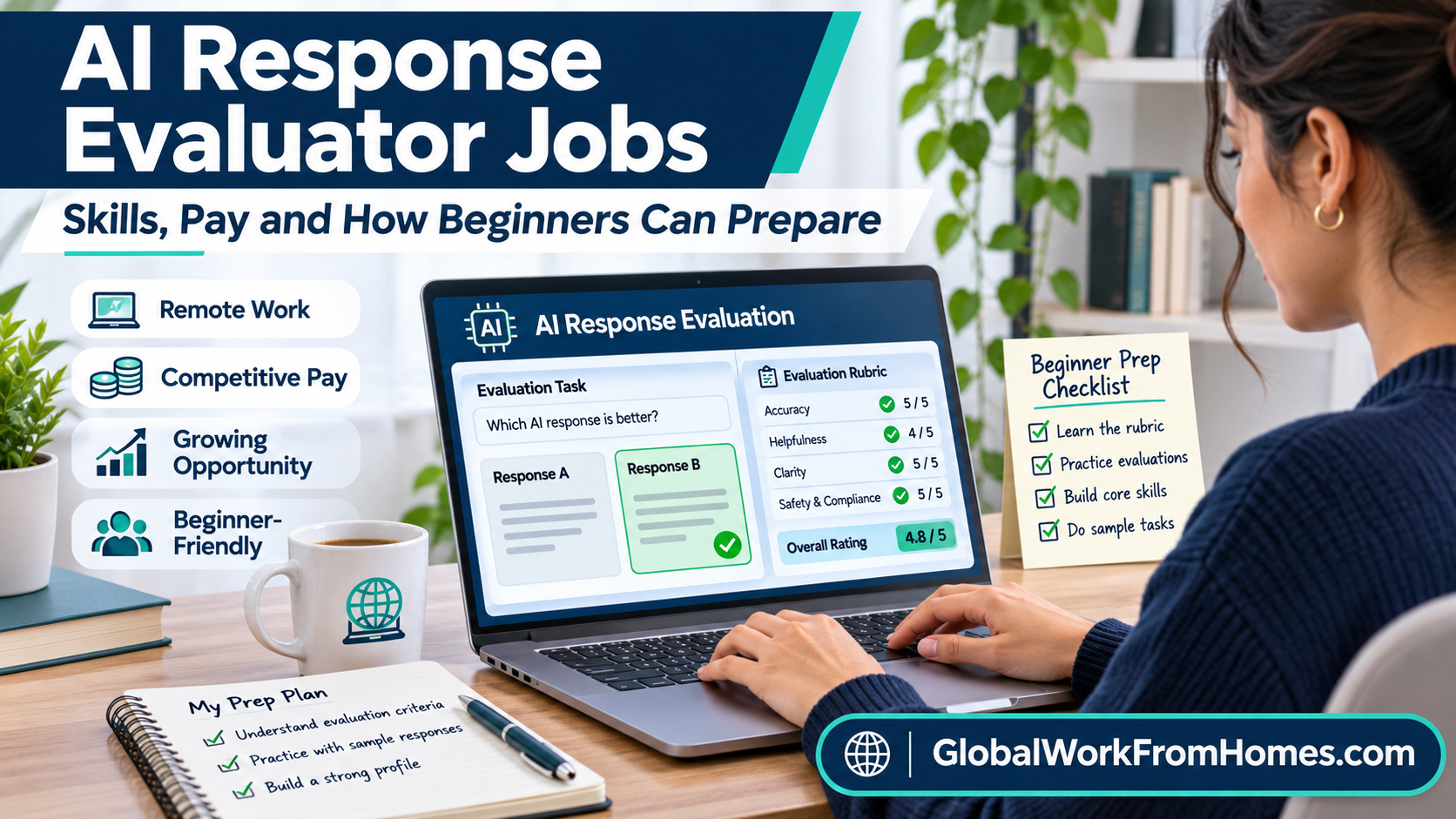
AI response evaluator jobs involve judging whether an AI-generated answer follows instructions, addresses the request and supports its claims. Some opportunities suit strong general writers; others require a subject qualification, language skill or professional background. Beginners should expect screening, location restrictions and variable project availability. A platform account or advertised hourly rate does not guarantee paid assignments.
This guide explains the work, compares official opportunity pages and gives you an original scoring exercise with justified answers. You will also learn how to build an honest practice portfolio, read payment terms and prepare an application. The goal is to help you decide whether the work fits your skills and income needs.
Official pages checked November 11, 2026. Requirements, rates and application availability can change. Published platform claims are identified as advertisements, not independently verified earnings or promises of acceptance.
On this page
- What AI evaluators actually do
- How beginners can judge their fit
- Official opportunities and eligibility
- How task pay and availability work
- The skills worth practicing
- A worked response-scoring exercise
- How to handle uncertainty and disagreement
- Build a truthful practice portfolio
- Apply for AI response evaluator jobs and prepare for screening
- A seven-day preparation plan
- Protect data and verify offers
- Frequently asked questions
What do AI response evaluator jobs involve?
An evaluator usually receives a task, an AI response and a set of rules. The task may ask you to score one answer, compare two answers, label an error or explain a preference. Your job is to apply the rules consistently. Personal taste alone is not enough when the rubric asks for factual accuracy or a specific instruction.
For example, a beautifully written answer can still fail if it changes the customer’s question. Likewise, a short answer can be better than a long one when the user asked for three brief steps. A useful evaluator separates the dimensions instead of giving every polished response a high overall score.
Assignments can also involve images, audio, video or specialist material. Therefore, check the actual project description rather than assuming every AI training vacancy involves writing about general topics. Some work requires technical tools, subject knowledge or exposure to difficult content that may not suit you.
Generalist and specialist evaluation
A generalist might assess clarity, completeness, reasoning and instruction following across everyday requests. A specialist might verify a programming solution, review a mathematical explanation or judge a response in a professional field. The specialist label matters because broad enthusiasm does not replace the required expertise.
When reviewing a vacancy, identify what you must know before starting and what the project teaches during onboarding. If a task requires expertise you do not have, do not guess your way through it. Choose a suitable project or use the project’s uncertainty and escalation process.
Related jobs are not all the same
Search rating, advertising relevance, data annotation and content safety can overlap with AI development, but their daily tasks differ. Search rating may involve judging whether a result matches a query. Annotation can involve applying labels to data. Content safety may involve classifying harmful material. None automatically means writing or ranking chatbot answers.
This distinction helps you choose the right preparation. A writing portfolio may help explain your response-evaluation reasoning, while an audio task might require careful listening and language knowledge. Read the task type, hardware requirements and assessment rules before investing time in an application.
Can beginners qualify for AI response evaluator jobs?
Some can, but “no AI experience” is different from “no relevant skills.” A beginner may already have strong reading, research, editing or analytical experience from another job or study. The application should show those abilities honestly. It should not invent a history of training models or working for clients.
Start with three questions. First, can you explain why one answer is better using the actual request? Next, can you distinguish a supported fact from an assumption? Finally, can you follow a detailed rule even when you personally prefer another result? If one answer is no, you have a practical learning target rather than a reason to buy an expensive course.
Formal requirements vary. A generalist page may welcome strong writers without a degree, while a specialist opportunity can require advanced study or professional credentials. In addition, country, language, residency and identity checks may apply. Passing an initial application also does not establish that work is available at the moment you want it.
A useful self-test is to evaluate your own short exercise twice, a day apart. Compare the scores and reasons. If your judgment changed, identify the rule or evidence responsible. That habit builds consistency and shows whether you are scoring the response itself or simply reacting to its style.
Official opportunities: what the public pages actually establish
These examples cover general response evaluation and adjacent rating work. Follow the official link to check the current version and local eligibility. A general interest form is listed separately from a role description, and an advertised rate is not presented as typical income.
| Official page | Type and entry conditions | Pay and availability limits |
|---|---|---|
| DataAnnotation: Generalist | Public description includes judging and improving AI responses. It emphasizes reading and writing; the reviewed page says a degree is not required. Country eligibility was not specified on that page. | Advertises up to $50 USD per hour, depending on work difficulty and specialization. This is a vendor ceiling, not a beginner rate or guaranteed workload. Check the application and project terms. |
| Outlier: Join Our Expert Community | Expression of interest / talent pool. The reviewed page listed selected countries and sought communication, attention to detail and professional expertise. | Advertised up to $18 USD per hour. Joining the community is not assignment to a paid project; eligibility and rates depend on the eventual work. |
| TELUS Digital: Evaluator, United States | Adjacent content and video evaluation with structured explanations, rather than a general chatbot-writing role. Listed English, US residency for three consecutive years and qualification checks. | Advertised $0.2333 USD per task minute, with an estimated $14 hourly equivalent. Contractor work depends on tasks and the stated productivity and quality conditions. |
| TELUS Digital: Personalized Internet Ads Assessor, English US | Adjacent advertising-relevance work. Listed US residency conditions and a qualification process. It should not be treated as the same job as evaluating conversational answers. | Check the current vacancy and offer for the payment unit, available tasks and eligibility. Do not transfer the other TELUS role’s rate to this role. |
Check the task type before you apply
The TELUS content-evaluation description also signals potentially difficult material. Read that section before applying and consider whether you are comfortable with the assigned content. A familiar platform name does not tell you whether a particular project is a good personal fit.
For broader background, browse our AI training and evaluation jobs category. The site also has a Mercor overview and a Handshake AI review. Those guides provide context; use each platform’s current official role page for an application decision.
Understand pay before relying on it
AI evaluation work may pay by hour, task, accepted item or another project-specific unit. An hourly equivalent is a calculation, not necessarily payment for every hour you spend online. Read how the platform treats task access, preparation, quality review and rejected work. If a term is missing, ask before assuming it favors you.
Consider this fictional example. A task pays $3 and takes 12 minutes, so five completed tasks would equal $15 for an hour of uninterrupted task work. If you spend an additional 30 minutes on unpaid setup and waiting, the same $15 covers 90 minutes of total time. That is $10 per total hour before expenses. Real terms differ, so track your own time and payments.
Also distinguish an advertised maximum from your offered rate. A high ceiling may apply to a specialist project, a particular country or a limited incentive. It does not establish what a new generalist will receive. Save the rate shown in your actual project invitation and check whether a different task changes it.
Treat availability as a separate question
A platform can accept your profile while offering no suitable tasks. A project can also pause after onboarding or change its workload. Consequently, avoid planning essential bills around work you have not received. If steady income is your main need, compare these opportunities with employee roles that provide a written schedule and base pay.
Before beginning, record the payment unit, approval process, payout method, timing and any disclosed fees. For contractor work, consider your own equipment, recordkeeping and applicable obligations when comparing offers. This guide does not estimate your take-home pay or interpret an individual contract.
Skills for AI response evaluator jobs
1. Read the request precisely
List the requested output, audience, constraints and source boundaries before scoring. For example, “explain in two sentences using only the supplied notes” creates different requirements from “research this topic.” An answer can contain true information and still break the source boundary or format instruction.
2. Check claims against the right evidence
Use the sources permitted by the task. If the task supplies all necessary facts, compare the response with those facts first. If external research is allowed, prefer authoritative material and check dates when the information changes. Do not cite a page merely because its headline sounds related.
3. Explain a decision with specific evidence
A useful rationale connects the request, a response detail and its effect. “Response B is better” gives no basis for review. “Response B identifies the evening schedule conflict using the supplied notes” gives another reviewer something to verify. Keep explanations proportionate to the issue.
4. Apply the same scale consistently
Define what each score means before using it. Otherwise, one response may receive a four for a small omission while another receives a two for the same problem. Recheck a few earlier examples after learning a new rule, and document why a score changes.
5. Write concise, neutral feedback
Describe the error rather than attacking the author or guessing intent. Remove praise that adds no evidence. At the same time, identify what the answer did correctly so the judgment is balanced. Clear writing makes your decision easier to audit and reduces disagreement caused by vague wording.
A worked AI response evaluation exercise
This exercise is original and fictional. It is not a platform assessment, leaked test or paid client task. You can reuse the method for private practice, but actual projects may use different dimensions and scoring rules.
The user’s request and supplied notes
Request: “Using only these notes, tell me whether this support job fits me. Give exactly three bullet points and no more than 90 words: fit, conflicts and next step.”
Notes: The candidate lives in Texas and is available only from 8 a.m. to noon Central Time. The employer permits Texas residents. The role requires fixed Tuesday-to-Saturday evening shifts and two weeks of training from 9 a.m. to 5 p.m. Central Time. Duties include phone, email and chat. The candidate wants no phone work. The employer requires a computer and wired internet; the candidate has a laptop and currently uses Wi-Fi. Pay is not provided.
Response A
- Fit: This is a perfect match because remote jobs let you choose your location and hours.
- Conflicts: There are none. Chat support is phone-free, and a smartphone is enough.
- Next step: Apply now and select morning shifts. You should be hired quickly.
Response B
- Fit: Texas is eligible, but the role does not fit your stated availability or phone-free preference.
- Conflicts: Evening shifts and full-day training exceed your morning availability. Phone duties are required. Your current Wi-Fi setup does not meet the wired-internet requirement.
- Next step: Search for a written-support role with compatible hours, or ask whether these requirements can change before applying.
The practice rubric
| Dimension | Weight | What a high score means |
|---|---|---|
| Accuracy | 50% | Claims agree with the supplied notes and uncertainty is preserved. |
| Relevance | 25% | The answer directly helps the candidate judge fit and choose a next step. |
| Instruction following | 25% | Exactly three bullets, at most 90 words, required topics and no unsupported outside claims. |
Score each dimension from one to five. One means serious failure, three means partly successful with a meaningful weakness, and five means fully successful for this exercise. Scores two and four sit between those anchors. This is an illustrative scale, not an industry standard.
Justified scores
Response A: accuracy 1/5, relevance 2/5, instruction following 1/5. It contradicts the schedule and phone requirements, changes the equipment rule and invents a hiring expectation. It discusses the requested topic and uses three short bullets, which gives it limited relevance and format credit. However, following the visible bullet format does not repair the instruction to use only the notes.
Response B: accuracy 5/5, relevance 5/5, instruction following 5/5. Using the supplied facts, it recognizes Texas eligibility while identifying the real conflicts. There is no invented pay or promise of an exception. The answer also follows the three-bullet and length requirements. The recommendation fits the candidate’s stated limits.
The weighted score for A is (1 × 0.50) + (2 × 0.25) + (1 × 0.25) = 1.25/5. The score for B is 5/5. These numbers summarize the reasoning, but the serious factual contradictions in A should also be flagged explicitly. A weighted average can hide a critical error if a project uses poorly chosen weights.
A concise improved answer
- Fit: Your Texas location qualifies, but this role conflicts with your hours and no-phone preference.
- Conflicts: It requires evening shifts, full-day training, phone duties and wired internet. Your stated availability and current connection do not meet those requirements.
- Next step: Prioritize written-support roles with morning hours. Ask about exceptions only if you would consider the job if those conditions changed.
This revision keeps the essential evidence and gives a practical next step. It does not add a salary, promise flexibility or tell the candidate to hide an eligibility problem. Notice that the better response is useful because it preserves the facts, not because it uses more sophisticated language.
Handle uncertainty and reviewer disagreement
Two careful evaluators can disagree about a borderline omission. Begin by checking whether they used the same request and rubric version. Then name the exact disagreement: a factual contradiction, missing detail, formatting issue or preference. That makes it easier to resolve the decision without arguing about whether an answer feels good.
Suppose one reviewer gives Response B a four for relevance because it could suggest checking the training schedule first. Another gives it a five because the conflicts and next step already answer the request. The useful discussion concerns the scoring anchor: does a five require every possible improvement, or successful completion of the stated task?
When evidence is missing, record the uncertainty rather than converting it into a fact. For example, an employer page that omits equipment provision does not prove that equipment is supplied or that it is not supplied. In an actual project, follow its rules for uncertain cases, abstention and escalation.
Finally, distinguish a minor wording preference from a material defect. A response can be clear without using your favorite phrase. Conversely, a friendly tone cannot cancel a wrong instruction that could lead the user to make a poor decision. Apply the same threshold across comparable answers.
Build a truthful practice portfolio
You do not need a large public website to begin practicing. A short document with three original exercises can show how you reason. Include the request, permitted facts, two sample answers, a rubric, scores and a brief improved answer. Label every item as an independent practice project.
Choose varied cases: a scheduling request, a factual summary and a comparison with explicit constraints. Keep the topics within your knowledge so you can verify the answer. If you use public sources, link them and record the access date. Do not imply that a fictional exercise came from a paying client.
For each exercise, include one revision note explaining what changed after review. For instance, you might notice that your first rubric mixed factual accuracy with tone. Separating those dimensions makes the next judgment more useful. This shows learning and quality control without inventing professional achievements.
Keep actual platform instructions, customer data and paid tasks out of a public portfolio unless you have explicit permission. A confidentiality requirement can apply even when a task looks ordinary. Our remote resume guide can help you present a simulated project separately from employment.
Apply for AI response evaluator jobs and prepare for screening
First, confirm that the opportunity accepts applicants in your location and matches your language or subject skills. Next, read the application instructions and prepare accurate background information. Use the role’s terminology when it describes your genuine abilities, but avoid a paragraph of keywords with no supporting evidence.
A useful experience bullet might describe reviewing written material against a checklist, documenting exceptions or comparing evidence before making a decision. Include an actual example from work or study. If your only evaluation experience is practice, say so and explain the exercise. You do not need to rename unrelated work as AI training.
Follow the assessment’s tool rules
Do not assume that a company building AI permits applicants to use AI during its screening. The instructions may require independent ratings or prohibit generated explanations. Read those rules before starting. Use practice exercises to learn beforehand, then complete the real assessment under its stated conditions.
During preparation, practice explaining a judgment in a few sentences. Identify the requirement, point to the relevant response detail and state the consequence. This approach is usually more useful than memorizing praise words such as clear, accurate or helpful without explaining why they apply.
Keep an application tracker with the official URL, opportunity ID, date, eligibility and status. Distinguish applied, assessment invited, accepted to platform and assigned to project. Those are different stages. If you compare several platforms, our Welo Data review and TELUS AI overview offer additional background to check against current official terms.
A seven-day preparation plan
- Day 1: Choose a work type. Decide whether you are preparing for text response evaluation, search rating or a specialist field. List location and language limits.
- Day 2: Read official descriptions. Compare at least three pages. Record whether each is a job, talent pool or general career resource.
- Day 3: Build a small rubric. Define accuracy, relevance and instruction following with clear score anchors. Keep dimensions separate.
- Day 4: Score two original answers. Use supplied fictional facts and write evidence-based reasons. Check any arithmetic in the scoring method.
- Day 5: Revisit your judgments. Review the exercise again and explain any changed score. Remove unsupported assumptions.
- Day 6: Prepare your application. Match truthful examples to one suitable opportunity. Check assessment rules and your device setup.
- Day 7: Apply and keep records. Save the role details and application status. Continue skill practice while waiting for an actual project invitation.
Extend any stage that needs more work. The plan is not a prediction that you will pass screening within a week. If you struggle to explain your scores, return to a smaller task with simpler facts. Consistent reasoning is a better preparation target than completing a large number of rushed exercises.
Protect data and verify offers
Use a platform’s official website to locate its application process. Verify an unexpected recruiter message independently before opening attachments or supplying identity information. The FTC’s job scam guidance warns about paying for employment promises and fake checks. Our remote job scam checklist provides additional checks.
For real assignments, follow the project’s data-handling rules. Do not paste client tasks or personal information into an unapproved public tool. Store only what you are allowed to keep, and use the prescribed reporting route for access problems. If a task contains material outside your assignment or authorization, stop and ask through the project process.
Also keep ordinary payment records and a log of time spent. These records help you compare advertised rates with actual results and identify a payment issue promptly. Never buy a supposed guaranteed account, share your identity to help someone bypass screening or let another person submit ratings through your profile.
Frequently asked questions
Do AI response evaluator jobs require a degree?
Some do and some do not. Generalist opportunities can emphasize writing and reasoning, while specialist work may require formal qualifications. Use the individual vacancy’s current requirements. A degree-free application still needs evidence that you can perform the task and comply with its rules.
Do AI response evaluator jobs require coding skills?
Not for every role. Text evaluation, language tasks and some relevance-rating projects differ from coding evaluation. However, do not apply for a technical specialty by assuming you can learn the required subject during a timed assessment. Choose work that matches your current knowledge.
Does passing screening guarantee regular work?
No. Account approval and project assignment are separate, and task availability can change. Read the invitation and payment terms carefully. If you need dependable hours, compare the opportunity with other work arrangements rather than treating an accepted profile as a salary.
What is the best first step?
Complete the original exercise above and justify each score using the supplied facts. Then compare one official opportunity with your location, skills and income needs. Apply only when the fit is clear, and keep practicing with original material while you wait.
Share this:
Get Free Remote Job Updates
Your next opportunity could be one email away.
🔒 Your privacy matters to us.
GlobalWorkFromHomes.com