
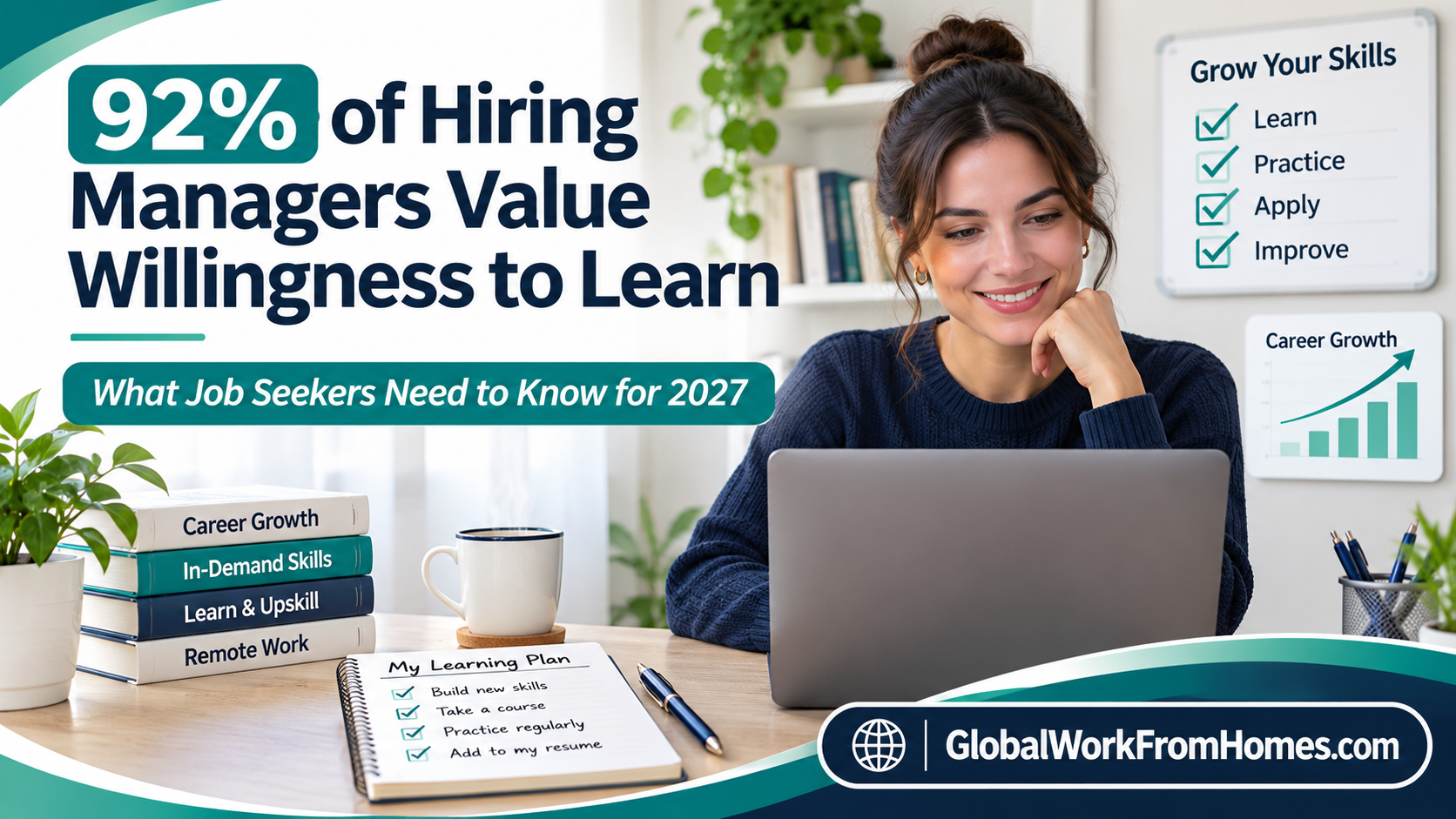
Employers are emphasizing learning potential alongside experience and qualifications, according to an Express Employment Professionals survey release published November 23, 2026. In the survey, 92% of US hiring decision-makers regarded willingness to learn as essential or very important for new employees.
The research, also covered by HR Dive coverage on November 25, offers useful context for people preparing for career changes and entry-level remote employment in 2027. It does not, however, establish that remote hiring is expanding.
Employers plan to invest in workforce training
The survey of 1,006 US hiring decision-makers found that 76% reported plans to reskill their employees, compared with 64% in spring 2025. Another 86% favored developing existing workers for newly created positions over hiring externally.
Among companies that planned to increase staffing in the second half of 2026, 37% were seeking expertise in new areas. These are reported preferences and intentions, not confirmed future job openings.
What the findings mean for entry-level applicants
For applicants without extensive professional experience, learning potential may provide a way to demonstrate readiness. Yet it is not a substitute for mandatory credentials or experience requirements. Employers can value adaptability while still requiring specific qualifications.
There is also a competitive consideration: if a company chooses to train existing workers for a new position, fewer opportunities may be available to external candidates. The findings therefore support a targeted approach to applying rather than a prediction of easier recruitment.
Five practical skills to develop before 2027
AI literacy: Learn to verify AI-generated information, recognize errors and protect confidential information. Practice evaluating outputs against clear requirements rather than assuming every response is accurate.
Digital communication: Develop clear writing, professional email habits and familiarity with online collaboration tools. Practice explaining a problem and summarizing a decision in a way that colleagues can act on.
IT fundamentals: Learn basic troubleshooting, security practices and cloud concepts. Microsoft Learn provides training resources for people exploring technology roles.
Data and spreadsheet skills: Practice organizing information, checking data quality and presenting simple reports. A small project can demonstrate these abilities more convincingly than a list of software names.
Independent problem-solving: Practice researching unfamiliar tasks, documenting your approach and recognizing when to seek help. These are editorial recommendations, not a ranking from the survey.
Does reskilling mean employers will offer paid training?
The study primarily concerns training existing workers. It does not establish that employers will provide paid training to all new hires. Before accepting an offer, ask whether training is compensated, how long it lasts and what employment terms apply afterward.
Be especially careful when an unfamiliar recruiter promises guaranteed employment in exchange for an upfront fee. Confirm the employer and the vacancy through official channels.
How to show that you are willing to learn
Instead of describing yourself as a fast learner, provide evidence. For example, complete a course, build a relevant project or demonstrate how you learned an unfamiliar process and applied it successfully.
When preparing for interviews, choose a specific example that explains the challenge, how you acquired the necessary knowledge and what you achieved. Keep your claims accurate and distinguish practice projects from professional experience.
Explore our remote jobs resource page to identify roles that fit your developing skills. The November remote job market report also provides additional context on the availability of remote opportunities.
The outlook for 2027
The survey highlights how employers are thinking about changing skill needs. For job seekers, the practical takeaway is to develop relevant capabilities and make that learning visible through evidence. Experience and qualifications remain important, but ongoing professional development can strengthen a well-targeted application.
Sources
Express Employment Professionals survey release — November 23, 2026. HR Dive coverage — November 25, 2026.
Share this:
Get Free Remote Job Updates
Your next opportunity could be one email away.
🔒 Your privacy matters to us.
GlobalWorkFromHomes.com