Physical Address
304 North Cardinal St.
Dorchester Center, MA 02124
Physical Address
304 North Cardinal St.
Dorchester Center, MA 02124
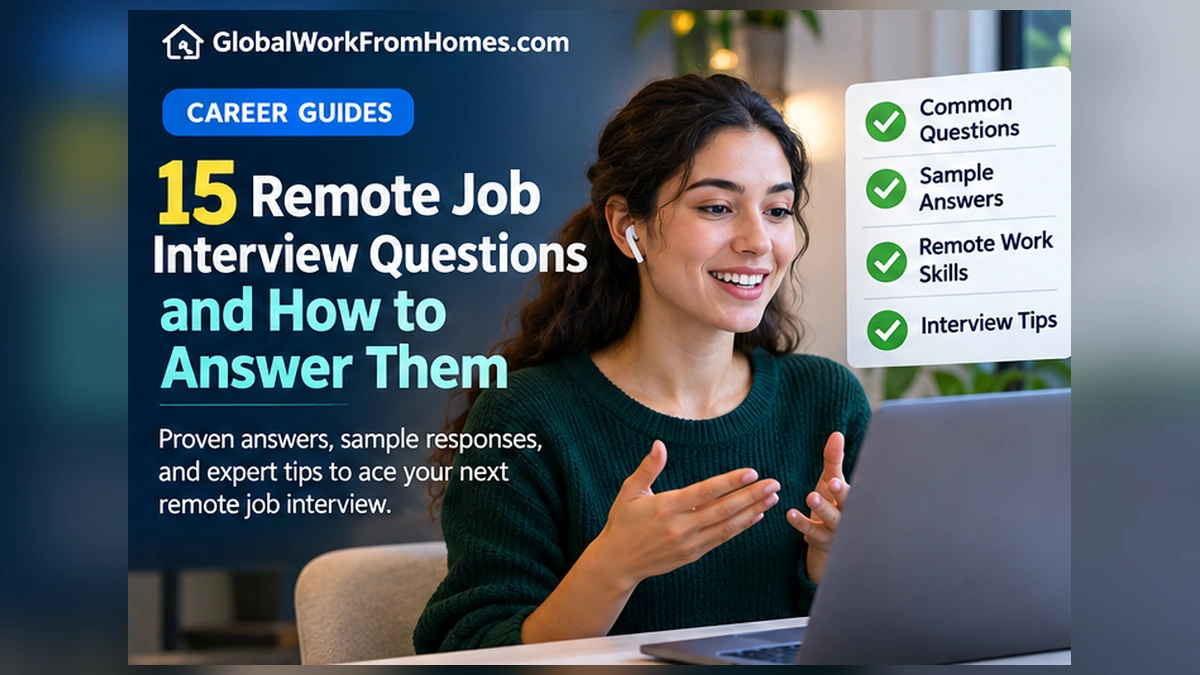


A strong remote interview answer shows that you can communicate clearly, plan your work, ask for help appropriately, protect information, and deliver results without someone standing over your shoulder. Prepare a short example for each skill. For behavioral questions, explain the situation, your responsibility, the action you took, and the outcome. For hypothetical questions, show how you would make a safe decision instead of pretending you have experience you do not possess.
A remote interview is still a job interview. The employer needs evidence that you can perform the role, collaborate with others, and handle the ordinary demands of work. The remote setting adds questions about written communication, scheduling, technology, distractions, accountability, cybersecurity, and uncertainty. Those themes appear whether you are applying for customer support, virtual assistance, sales coordination, content work, junior technical support, or another remote position.
There is no universal script that guarantees an offer. Memorized answers can sound unnatural, and identical responses rarely suit every company. The better method is to practice concise, true stories you can adapt. This guide provides fifteen realistic questions, sample answers you should personalize, explanations of what interviewers may be assessing, and preparation exercises. The examples are illustrations; never present them as events that happened to you unless they genuinely did.
The U.S. Department of Labor’s CareerOneStop virtual interview guidance (https://cloudfront.careeronestop.org/JobSearch/Interview/virtual-interviews.aspx) recommends reviewing the job description, practicing answers, testing your equipment, preparing your space, and doing a mock interview. Those basics remain useful even when the interviewer seems informal.
You don’t need fifteen unrelated stories. Prepare five true examples that demonstrate communication, organization, problem solving, learning, and handling a mistake. Each should answer: What happened? What were you responsible for? What did you do? What happened afterward? A school project, volunteer assignment, family business, or in-person job can provide relevant evidence if you describe its context honestly.
Make a short note with no more than five lines per story. For example: “Retail shift; customer received wrong item; checked order and policy; gave accurate options; supervisor handled exception; customer received clear next steps.” You now have material for questions about customer service, pressure, problem solving, and escalation. Do not force the same story into every answer; rotate examples so interviewers see different strengths.
Practice out loud. A clear 45–90-second answer often communicates more than a three-minute speech. For complex questions, a longer answer may be useful, but ask yourself whether each sentence supplies evidence. CareerOneStop also recommends researching the employer and preparing questions of your own: see its interview preparation guide (https://cloudfront.careeronestop.org/JobSearch/Interview/get-ready.aspx?frd=true).
This usually opens the conversation. The employer is not requesting your life history. They want a concise summary of your relevant background, what you can contribute, and why this particular role makes sense. The danger is spending the entire answer on convenience—avoiding a commute, staying at home, or having a flexible schedule—without mentioning the work itself.
Sample answer: “I have experience supporting customers and keeping accurate records in a busy retail environment. I learned to listen carefully, explain policies clearly, and ask a supervisor when an issue required a decision outside my authority. I am now applying for remote customer support because the role uses those same communication and documentation skills. I’ve also practiced professional email replies and spreadsheet ticket tracking, and I would like to contribute those skills in a structured support team.”
Make it yours: Replace the background and examples with true details. Mention the employer’s actual product or customers if you researched them. If you are applying to a remote job for family or geographic reasons, it is fine to value the arrangement, but lead with the contribution you can make.
Interviewers want to know whether you have paid attention to the organization rather than applying indiscriminately to every remote posting. A persuasive answer connects a specific product, customer group, service, or value to something you can contribute. You do not have to claim that the company has been your dream employer since childhood.
Sample answer: “I noticed that your support team serves small business owners, and your website emphasizes clear, timely help. I enjoy explaining processes in plain language and keeping notes so the next person can pick up an issue without repeating work. The job description’s focus on written communication and problem ownership matches the skills I want to use and develop.”
Make it yours: Check the official company website, recent announcements, product pages, and the job description. Choose one grounded detail. Avoid generic flattery such as “Your company is the best” or unsupported praise about the culture. A thoughtful question about how the team measures helpful service is often more impressive than exaggerated enthusiasm.
Remote workers may receive requests from different people through email, chat, tickets, and project tools. The interviewer is assessing priorities, reliability, and your ability to report progress, not whether you have bought a sophisticated productivity app. An effective answer explains how you choose important tasks, protect time for focused work, and update stakeholders.
Sample answer: “I start by checking deadlines and any urgent customer or team issues. I place my work in a simple task list with owners and due dates, then identify the first two priorities. I use calendar blocks for tasks that need uninterrupted attention and leave time for messages. If a deadline looks at risk, I let the person responsible know early, explain the blocker, and propose an alternative instead of waiting until the last minute.”
Make it yours: If you used this method in school or an on-site job, say so. Give a real example of balancing competing requests. If the role has shift schedules or real-time service queues, acknowledge that customer urgency may override planned individual work.
Text lacks voice tone and body language. Remote colleagues can reach different conclusions from a short instruction like “handle this today.” Employers want evidence that you can clarify respectfully without making every conversation into a meeting. A good answer includes context, the specific question, and confirmation of the result.
Sample answer: “First I reread the message and check the related task or policy so I do not ask something already documented. If there are two reasonable interpretations, I summarize my understanding and ask a specific clarifying question. For example: ‘Do you want the updated report by noon your time, or by end of day?’ After we agree, I record the deadline in the task and confirm any dependencies.”
Make it yours: Explain a true example of a misunderstanding you helped prevent. Avoid saying you never misunderstand instructions. Good communication is not absence of ambiguity; it is recognizing uncertainty early enough to resolve it.
This is a behavioral question. Use an actual event and explain your boundaries. Employers value independent judgment, but independence does not mean acting without authorization. For technical, customer-data, billing, or security issues, knowing when to escalate is part of competent problem solving.
Sample answer: “During an evening shift, a customer reported a mismatch between the product received and the receipt. The supervisor was assisting another person. I verified the receipt, checked the item details, reviewed the return policy, and documented the discrepancy. I explained what I could confirm and which decision needed supervisor approval. When the supervisor was free, I provided a short summary with the evidence, so the issue could be resolved without asking the customer to repeat everything.”
Make it yours: Add the actual outcome if you know it. State which parts you handled and which decision belonged to someone else. This answer is stronger than claiming you fixed a complex problem alone when you really needed help.
Every remote worker may encounter technical disruption. The question tests preparation, communication, and responsible use of backup methods. It does not require an expensive home network. Be honest about the resources available to you and any employer policies that restrict use of personal devices or public networks.
Sample answer: “I would first check whether the problem affects my device or the connection and use the company’s approved troubleshooting steps. If I cannot restore access quickly, I would contact my supervisor through the approved backup channel, explain which work is affected, and give a realistic update. I would not move confidential files to an unapproved personal account just to keep working. Once service returned, I would check outstanding tasks and confirm priorities.”
Make it yours: Mention a backup connection only if you truly have one and are permitted to use it. A thoughtful answer distinguishes a minor inconvenience from a security or service incident that needs timely escalation.
The best answer describes workable habits rather than claiming a distraction-free life. Remote work environments vary widely, and companies may have requirements for private customer calls or handling confidential records. The relevant question is whether you can meet job obligations and communicate if an unexpected problem affects coverage.
Sample answer: “I maintain a designated work area and use calendar reminders for my shift and meetings. I turn off unrelated notifications during focused work, keep my task list visible, and check messages at intervals appropriate to the job. For calls involving private information, I use a quiet space and headphones. If an unexpected disruption affects availability, I communicate promptly through the team process rather than disappearing.”
Make it yours: Do not volunteer unnecessary private details. If your household cannot support specific required working conditions, address that realistically before accepting the role. The interviewer may ask about equipment, schedule, or confidentiality rather than your family circumstances.
This tests prioritization and communication. A weak answer says “I work harder and do both.” A strong answer recognizes that urgency is not the same as business impact. Consider safety, customer effect, contractual commitments, dependencies, and whether another person can act while you complete one task.
Sample answer: “I would check the impact and actual deadlines for both tasks. If one affects a live customer outage or another person’s ability to continue, I would prioritize it according to company policy. If both genuinely need immediate attention, I would contact my manager with a brief summary: what each task requires, what I can complete, and which trade-off needs a decision. I would update the task owners so nobody is left assuming work is underway.”
Make it yours: Offer an example from an in-person environment if you lack remote experience. What matters is the decision process, not the location where it occurred.
Everyone makes mistakes. The interviewer wants accountability, a proportionate correction, and evidence that you changed a process. Avoid choosing a serious integrity violation or inventing an artificial weakness that sounds like praise. Do not blame a coworker or expose confidential facts.
Sample answer: “On one project, I used an old version of a shared checklist and missed a change in the deadline. I noticed the discrepancy when comparing notes with a teammate. I told the team, corrected the tracker, and helped adjust the remaining work. Afterward, I used a single shared document with a version date and made checking updates part of my daily routine. That improved how I handled shared instructions.”
Make it yours: Select a real example with a manageable consequence. Explain what you personally did and what outcome followed. The learning should be visible in changed behavior, not just “I learned to pay attention.”
Distributed teams often depend on written feedback, which can feel blunt. Employers want coachability and professional judgment. The answer should neither promise to agree with everything nor portray you as someone who debates every correction. Separate the feedback’s stated standard from your interpretation of it.
Sample answer: “I would listen or read the feedback fully before responding. I would ask for a specific example if the expectation was unclear, then compare my work with the agreed standard. If I saw information that the reviewer might not have, I would share it respectfully, along with the evidence. Once the decision was clear, I would update the work and note the guideline so I could apply it consistently next time.”
Make it yours: Describe one authentic instance when feedback improved your result. A good story shows curiosity, not defensiveness. If the request conflicts with a legal or security rule, say you would raise it through the appropriate channel instead of complying silently.
Written customer support requires empathy, accuracy, and boundary awareness. The employer may assess whether your response acknowledges the problem, gathers enough information, avoids unsupported promises, and gives clear next steps. Speed matters, but incorrect assurances can create larger problems.
Sample answer: “I would acknowledge the inconvenience without blaming the customer, check the account or order using approved access, and explain what I can confirm. If I need information, I would ask only for what the process requires. I would give a clear next step and time frame if the policy provides one. If the issue is outside my authority, I would escalate it with a concise summary so the customer does not have to repeat the situation.”
Make it yours: Prepare a short sample response to a fictional delayed-order complaint. Keep it human and specific. Avoid “I guarantee a refund” unless the employer’s actual policy and your authority permit it.
This question may appear in healthcare, finance, education, customer service, IT, and administrative interviews. You do not need to recite every security standard. Show that you understand access boundaries, approved devices, secure accounts, shared spaces, incident reporting, and the danger of forwarding data to personal tools.
Sample answer: “I use company-approved applications and follow least-access instructions. I do not send customer records to personal email, store passwords in shared notes, or use public links for confidential files. I lock my screen when away and verify a recipient before sharing information. If I receive a suspicious request or notice that information might have been exposed, I document what happened and report it promptly through the approved channel rather than trying to hide it.”
Make it yours: Mention specific controls you have actually used, such as multifactor authentication or password managers. Do not claim knowledge of regulations you have never studied. An entry-level answer can be strong when it demonstrates sound judgment.
The interviewer is trying to understand your starting level, not necessarily looking for every product name on the market. Tools differ among employers. Be concrete about actions: writing shared documents, tagging comments, tracking a ticket, joining video meetings, updating a Kanban board, or organizing calendar invitations.
Sample answer: “I have used Google Docs to collaborate on shared writing, Sheets for basic task tracking, and video meetings for school projects. I can create and share a document, use comments, filter a simple sheet, and join a meeting with audio and screen sharing. I have not used your specific ticketing system in production, so I would complete the onboarding exercises and follow team documentation before managing live cases.”
Make it yours: List only real experience. If you have used a tool casually, explain the functions you know rather than labeling yourself advanced. Being comfortable learning software is useful, but describe a true instance of learning a new tool.
Remote staff may receive requests by chat, email, or shared documents without a chance to ask a question face to face. The interviewer wants to see judgment, documentation, and appropriate escalation. It is not enough to say “I always follow instructions,” because some instructions can be mistaken, unauthorized, or malicious.
Sample answer: “I would check the written policy and make sure I understood the request. If it involved sharing credentials, bypassing an approval, or exposing customer data, I would not proceed on the assumption that a chat message makes it authorized. I would ask the requester to clarify and confirm through an approved channel. If the concern remained, I would escalate it to the appropriate manager or security contact, recording only the necessary details.”
Make it yours: If you have a past example, explain how you resolved ambiguity without accusing colleagues. This answer is especially relevant for virtual assistants handling accounts, invoices, or customer records.
This question can sound intimidating, but it is a chance to connect evidence to the role. Avoid apologizing for your background or claiming that remote work is easy. Show the employer the overlap between what you have done and what the role needs, plus an honest plan for any learning gap.
Sample answer: “While my previous experience has been on-site, the core responsibilities overlap with this position: accurate documentation, respectful customer communication, meeting deadlines, and knowing when to escalate an issue. I can describe situations where I handled those tasks reliably, and I have practiced the digital tools that support similar work. I understand your team will have its own procedures, and I am prepared to learn them while asking clear questions and keeping people updated.”
Make it yours: Replace broad skills with one or two specific examples. If the role requires technical credentials or specialized work you lack, don’t imply the interviewer should disregard the requirement. Show that you understand the learning path and fit.
Prepare your interview space in advance. Test the precise meeting link or platform, camera, microphone, speakers, and internet connection. Position your camera at eye level where possible, choose lighting that makes your face visible, and reduce background noise. Silence unrelated notifications and close private or distracting tabs before sharing your screen. Keep your resume and a few brief notes available, but avoid reading full paragraphs word for word.
Write down the interviewer’s name, company, role, and the official recruitment contact. For security, verify unexpected interview invitations against the company’s actual careers channel rather than clicking suspicious links automatically. The FTC warns that job scammers impersonate recognizable employers and sometimes rush candidates toward text-only interviews or sensitive paperwork. An interview invitation is not proof that a recruiter is legitimate: see the FTC’s guidance (https://consumer.ftc.gov/consumer-alerts/2023/11/searching-job-work-remotely-avoid-scams-identity-theft).
If something technical fails during the interview, stay calm. Rejoin once, use the official backup contact if provided, and send a short message explaining what happened. Don’t make the interviewer guess whether you abandoned the meeting. Remote interviews test communication during imperfect conditions as much as they test polished answers.
For behavioral questions, use Situation, Task, Action, Result (STAR) as a memory aid rather than a formal speech. Spend a little time on the setting, explain your specific responsibility, describe what you actually did, and finish with the result or what you learned. Avoid telling a long story about what the team did without revealing your individual contribution.
For hypothetical questions—“What would you do if a client requested a password?”—do not manufacture a past incident. Describe a sensible process, relevant policy, and escalation point. You can begin “I haven’t encountered that exact case, but my approach would be…” This demonstrates honesty and structured thinking. If your answer depends on company policy you have not seen, explicitly state that you would verify it.
Prepare answers in bullet outlines, not full scripts. Practice once with a timer and once with a friend who can ask follow-up questions. You should be able to adapt when the interviewer changes a condition: the customer is angry, the supervisor is offline, the task is urgent, or the requested action requires approval.
An interview is also your chance to evaluate whether the job is legitimate and appropriate. Ask what a typical workday looks like, how the team communicates, which hours and time zone apply, how employees receive training, what performance metrics are used, and how urgent requests are escalated. Ask whether equipment is provided, whether the company expects particular internet or private workspace conditions, and how it protects employee and customer information.
For entry-level roles, ask what successful performance looks like after the first 30, 60, and 90 days. A good employer can usually explain onboarding responsibilities and who reviews your work. For contract roles, understand payment terms and whether the position is employee work or independent contracting. An attractive salary headline should not replace a written explanation of responsibilities and classification.
If a purported recruiter refuses to identify the legal employer, asks you to send money to start, or requests banking information before you have verified an actual hire, stop and independently verify the offer. The FTC’s job-scam resource (https://consumer.ftc.gov/articles/job-scams) provides practical steps for this situation.
Within a reasonable period, send a brief thank-you message if you have an appropriate official contact. Mention a meaningful discussion point and reinforce how one of your skills fits the role. Example: “Thank you for explaining how the team handles customer requests. I appreciated hearing about the emphasis on documentation and timely escalation. My experience recording customer issues and following established procedures would help me contribute as I learn your platform.”
If you promised a sample or other information, send only what was requested and verify the recipient. Record the date, interviewer, next step, and expected follow-up window. Do not send daily messages when the employer has given a timeline. If no timeline was provided, a concise follow-up after several business days may be appropriate, depending on the context.
Treat rejection as data, not proof that you can never work remotely. Ask for feedback when appropriate. Review which questions were hard to answer, whether your evidence matched the posting, and whether the job required skills you need to develop. Focus on what you can improve, but recognize that hiring decisions also reflect competition and internal employer constraints.
Monday: Read the job posting carefully. Mark the main duties and required skills. Select five evidence stories from work, school, volunteering, or projects. Tuesday: Practice questions 1–5, recording yourself once if comfortable. Listen for excessively long introductions and missing results. Wednesday: Practice questions 6–10, including one realistic technical interruption scenario and an honest discussion of mistakes.
Thursday: Practice questions 11–15 and refine examples relevant to the position. Friday: Perform a mock video interview using the actual platform or a comparable one. Ask a friend to interrupt with two follow-up questions. Saturday: Research the employer, rehearse two useful questions, and test meeting logistics. Sunday: Rest and prepare a small note sheet with evidence prompts rather than memorized paragraphs.
After every practice round, review whether your answers contain facts, actions, boundaries, and outcomes. An answer that sounds confident but cannot survive “What did you personally do?” needs work. An answer that admits uncertainty and describes a reliable checking process can be stronger than a polished but unsupported claim.
Overemphasizing flexibility: Employers are hiring for output, not simply offering a location benefit. Discuss how you will perform the job. Claiming every tool: Name the functions you have actually used. Vague examples: Replace “I work well under pressure” with a concrete incident. Blaming others: Explain how you responded and what you controlled. Inventing remote experience: Transfer in-person skills honestly rather than fabricating a history.
Ignoring security: Do not assume a remote role permits personal email, shared logins, or unapproved software. Failing to test audio: A one-minute equipment check can prevent avoidable disruption. Reading a script: Keep short evidence notes and speak naturally. Saying you never need help: Explain how you distinguish independent tasks from issues that require authorization. Accepting suspicious recruitment: Verify employers and never pay for the promise of a job.
These are not merely etiquette points. They reveal whether you understand collaboration, confidentiality, service, and reliable communication. Remote managers cannot watch every task in person; a candidate who explains transparent updates and sound escalation habits reduces uncertainty.
Not necessarily. Many questions are the same, but video and phone interviews introduce technology, timing, and communication considerations. Prepare the role-specific answers and the technical setup separately.
Say so honestly. Explain adjacent tools you do know, show evidence of learning software, and ask about onboarding. Do not claim professional use after a short tutorial.
Make them long enough to supply context, action, and outcome, but short enough for follow-up questions. Around one minute is a useful practice target for many behavioral questions, not a strict rule.
A brief outline is usually helpful, but avoid reading full scripts. Keep your focus on the interviewer and use notes to remember examples rather than substitute for conversation.
Dress appropriately for the employer and role, with clean, professional clothing. A video interview still forms part of a professional selection process even if the job is fully remote.
Describe the setup and availability you actually have. If confidentiality or specialized equipment is required, ask for the employer’s exact policy and consider whether you can comply.
Use authentic coursework, volunteer activities, personal projects, or organized responsibilities. Clearly state the setting and your role. The story matters because it demonstrates behavior, not because it came from a formal payroll job.
Follow the context. It is reasonable to clarify a published range, work classification, hours, and benefits. Avoid giving sensitive financial details to an unverified recruiter, and confirm the official employer before proceeding.
No single feature proves fraud. However, the FTC identifies unusually rushed text-only recruitment and early requests for sensitive information as warning signs in some impersonation scams. Verify the job independently when a process seems unusual.
Pause briefly, ask to clarify the question, or take a moment to select an example. A thoughtful answer is preferable to rushing into a claim you cannot support.
The strongest remote interview answers connect genuine experience to the job’s responsibilities, reveal how you communicate and prioritize, and show when you would ask for help. Use these fifteen questions to prepare evidence, not to memorize a fictional personality. Research the employer, test your technology, give concise and truthful examples, and ask questions that help you evaluate the role. That approach gives both sides a better basis for a hiring decision.