


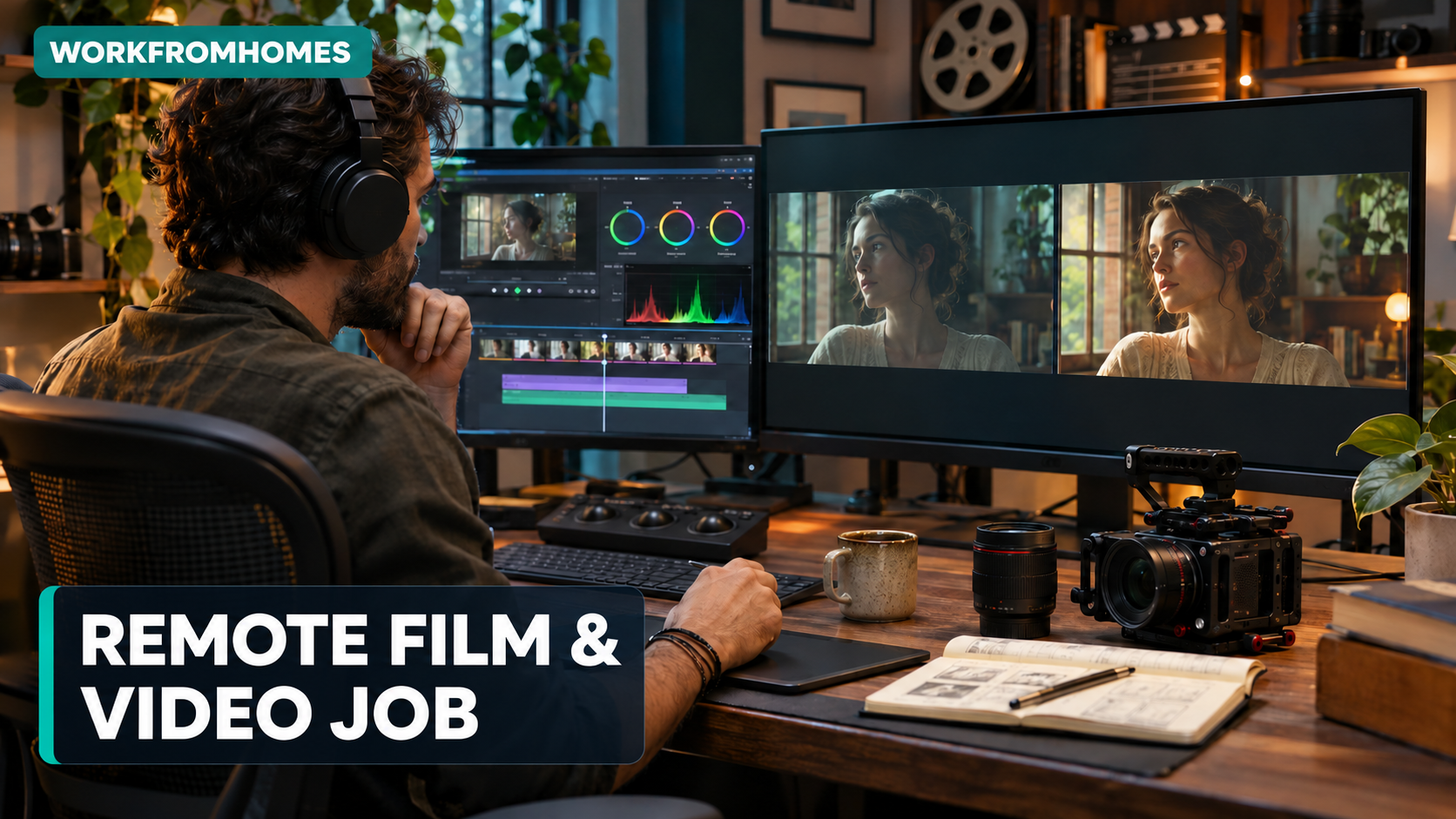
Quick answer: The Mercor Film & Video Craft Expert role is a remote, part-time opportunity advertised at $70–$100 per hour. It is designed for experienced film, theater, animation and visual effects professionals who can compare AI-generated videos and explain their judgments. Applicants need to offer at least 20 hours per week during weekdays.
If you regularly spot a drifting eyeline, an implausible camera move, an inconsistent grade or an unconvincing performance, this project could use that professional judgment. The main assignment is to review video outputs against a prompt and a defined set of craft standards, then write concise feedback that another reviewer can understand.
Listing checked: November 16, 2026. The official role page displayed an application form when reviewed. Availability, eligibility and final terms can change; review the current listing before applying.
Referral disclosure: Global Work From Homes may receive a referral reward if you apply through our link and meet Mercor’s qualifying conditions. A referral does not guarantee selection, project work or earnings.
Review the role and apply through Mercor →
In this guide
- Job details at a glance
- What the video evaluation work involves
- Experience and qualification requirements
- Pay, weekly hours and payment terms
- Display, headphones and remote setup
- How to apply
- Prepare your resume and work examples
- Example of a useful video judgment
- Who should consider this role?
- Application checklist
- Frequently asked questions
- Sources and related guides
Mercor Film & Video Craft Expert job at a glance
| Detail | Information |
|---|---|
| Company posting the role | Mercor |
| Official job title | Film & Video Craft Expert (Camera, VFX, Editing & Performance) |
| Advertised pay | $70–$100 per hour |
| Work arrangement | Fully remote; listed as part-time |
| Engagement | Independent contractor, according to the current listing’s contract terms |
| Availability requirement | At least 20 hours per week during weekdays |
| Main assignment | Compare AI-generated videos and write specific craft-based explanations |
| Experience level | Professional or graduate experience, plus one of the stated training/experience pathways |
| Language | English fluency; listed additional dubbing languages are a plus |
| Equipment named | A good-quality display and headphones |
| Payment | Weekly via Stripe or Wise for services rendered |
| Location eligibility | Listed as remote; the reviewed role text does not give a complete country or US-state eligibility list |
| Application route | Mercor referral application link |
Mercor describes its business as connecting human expertise with projects that train and improve AI systems. For this opening, the client is described as a leading AI lab. The reviewed job text does not name that lab, so applicants should avoid assuming a particular client or video model is involved.
What the video evaluation work involves
The project asks reviewers to judge pairs of videos generated from the same prompt. A pair may look impressive at first glance while differing sharply in whether it delivers the requested shot. Your task is to identify those differences and explain which output performs better on the assigned criteria.
For example, a video can have attractive lighting but fail to maintain a character’s position. Another can preserve continuity while delivering the wrong camera movement. A useful review separates those observations. That lets the project team understand the reason for a preference instead of receiving only an unexplained choice.
Compare the requested craft elements
- Lighting and color: Assess whether illumination and grading support the scene and remain coherent as the shot develops.
- Framing and composition: Check subject placement, shot size and whether the frame meets the requested visual brief.
- Camera and lens direction: Examine whether movement, perspective and the apparent lens treatment match the prompt.
- Texture and physical realism: Notice unstable surfaces, implausible interactions and details that change without a scene-based reason.
- Continuity: Track whether people, objects and spatial relationships remain consistent across the video.
- Performance and dialogue: Evaluate acting choices and delivery, including whether the performance follows the requested direction.
Explain the judgment clearly
Mercor wants short, precise reasons in language familiar to a production review. A strong note identifies the relevant moment, names the issue and explains its effect. Rather than writing that a clip feels strange, explain that the performer’s hand changes shape while touching a prop or that a camera move reverses direction halfway through the shot.
Reviewers also check prompt compliance, participate in calibration rounds and flag unclear instructions. Calibration helps the group apply the same standard to similar cases. If two reviewers disagree, the useful next step is to compare the evidence and the rubric, then resolve the interpretation through the project’s process.
Mercor Film & Video Craft Expert requirements
This opening is aimed at people with relevant professional or graduate experience. Watching films closely or experimenting with AI video tools may help you understand the assignment, but the listing also sets specific experience pathways. Read those pathways before investing time in an application.
Relevant professional backgrounds
The role accepts experience from several parts of film, theater and post-production. These include camera operation and first assistant camera work; editing; compositing; lighting; texture and surfacing; render wrangling; color and digital imaging work; and display or audiovisual quality assurance.
Other relevant backgrounds include directing, assistant directing, acting coaching or teaching, character technical direction, and character animation focused on human performance. Film or theater graduate experience, including current graduate study, is also named. Candidates should connect their own background to the evaluation criteria rather than imply they have worked in every department.
Two stated training and experience pathways
- Pathway one: Training at a respected film, theater or animation program, together with at least two years of practical experience.
- Pathway two: At least four years of practical experience, including at least two projects with a theatrical release.
The theatrical-release condition belongs to the second pathway. The reviewed text does not apply that same condition to both routes. If your credits, graduate work or program do not fit neatly into either description, ask Mercor how it assesses equivalent experience. Do not assume that an online release automatically counts as a theatrical release.
Language and communication
Applicants need fluent English and the ability to describe visual or performance problems in clear writing. French, Italian, German, Spanish, Portuguese, Korean or Hindi proficiency is listed as a strong plus for dubbing-related work. Those additional languages are presented as advantages, rather than a requirement to speak all of them.
The role also requires dependable weekday availability. Being technically qualified is only part of the match: you must have enough time to review carefully, follow updated guidance and collaborate when calibration is needed. State your actual availability instead of promising hours that conflict with existing productions or commitments.
Mercor Film & Video Craft Expert pay and weekly hours
The advertised range is $70–$100 per hour. This is a listing range, so applicants should confirm the specific rate in any offer before accepting. The posting does not establish that every selected reviewer will receive the highest rate, nor does it explain a formula for placing candidates within the range.
The time requirement is at least 20 weekday hours each week. That describes the availability Mercor wants from a contributor. It does not establish a guaranteed allocation of 20 paid hours every week. The contract terms say projects may be extended, reduced or ended early depending on project needs and performance.
The listing describes flexible scheduling and weekday participation together. Before accepting, clarify any deadlines, required overlap, calibration sessions or turnaround expectations. A production professional balancing this project with shoot days should understand how those requirements work in practice.
According to the current role text, contractors receive weekly payments through Stripe or Wise for services rendered. Confirm the method available to you, how work is recorded and which payment rules apply during onboarding. The reviewed job description does not say that all application or assessment time is paid.
The current contract section describes an independent-contractor engagement. Read the agreement offered to you for the actual terms. Mercor also states that this work will not involve using confidential or proprietary information belonging to another employer, client or institution. Prepare examples you are entitled to discuss and share.
Display, headphones and remote setup
The equipment requirements specifically name a good-quality display and headphones. Those tools matter because you are judging image quality and dialogue, not simply checking that a file plays. The reviewed text does not specify a required monitor brand, resolution, headphone model or calibration device.
As practical preparation, check that your setup can play sample clips smoothly and that the headphones reproduce dialogue clearly. Choose a viewing environment with manageable glare and distracting noise. If your equipment introduces obvious playback problems, it will be harder to separate a problem in the video from a problem in your setup.
Do not buy expensive hardware based only on this article. Ask about any required display settings, viewing software and technical specifications first. The role description does not say that Mercor supplies equipment or reimburses purchases, and it does not name a mandatory editing-software subscription.
How to apply for the Mercor Film & Video Craft Expert role
Apply through Mercor rather than sending an application to Global Work From Homes. The application form visible on the official role page when reviewed requested a full legal name, an email address and a LinkedIn URL, with an option for people who do not have LinkedIn. Later requirements should be checked in the application itself.
- Open the listing. Use the Mercor application link and confirm that it displays the Film & Video Craft Expert opening.
- Read the current terms. Recheck the rate, availability requirement, location rules and contract details before starting.
- Prepare your experience evidence. Have an accurate resume, relevant credits and shareable portfolio links ready if requested.
- Enter your details. Complete the information and any additional steps shown in your Mercor account.
- Follow the role’s screening instructions. Complete only the assessments or interviews Mercor actually assigns to your application.
- Review any offer. Confirm the rate, expected work, payment process and agreement before accepting.
The reviewed role description does not promise a fixed interview length, assessment format, response deadline or hiring timeline. Preparation advice in this guide is editorial guidance, not a confirmed Mercor test. Follow the instructions shown in your application if they differ from a general job-search guide.
The posting says Mercor cannot support H-1B or STEM OPT candidates for this role at present. It also does not provide a full location-eligibility list in the reviewed text. Check the current application and ask Mercor about your situation before treating a remote label as confirmation that you can participate.
Check current eligibility and apply on Mercor →
Prepare your resume and work examples
Your application should make the connection between your actual credits and this evaluation assignment easy to see. A list of software packages alone will not show how you recognize a continuity error or explain a performance choice. Choose examples that demonstrate the judgment you would bring to reviewing video.
Make your contribution to each project clear
For each relevant credit, identify the production, your department or role, your responsibilities and the period involved. Where useful, add the release format or a link to a public credit. Distinguish work you personally completed from work delivered by the wider team, particularly on large VFX or animation productions.
A camera professional could describe maintaining focus or checking shot continuity. An editor could explain identifying a spatial mismatch between shots. A compositor could discuss recognizing an integration problem. A performance coach could describe giving an actor a precise adjustment. Use a true example from your own work rather than copying these descriptions as achievements.
Choose evidence that supports your strongest area
A short, relevant selection can be easier to assess than an unexplained collection of links. If asked for a reel or portfolio, tell the reviewer where your contribution appears and what it demonstrates. An accurate note about one sequence is more useful than a broad claim that you handled everything in a production.
Students should label student projects and practical placements accurately. Experienced freelancers should explain their responsibilities without turning client-confidential details into application material. The goal is to provide enough context to establish relevant experience while respecting the limits on what you can share.
Practice concise written explanations
Before applying, watch a short clip that you own or may legitimately review. Write two or three sentences about one visual or performance issue. Identify the relevant moment, describe what happens and connect it to the brief. Then remove vague phrases and repeated observations without losing the evidence.
If interviews are part of your assigned process, prepare a true example of receiving feedback, resolving a creative disagreement and applying a shared standard. Our remote job interview questions guide offers broader practice for communicating clearly about remote work.
Example of a useful video judgment
Practice example created for this guide: The following fictional scenario illustrates clear evaluation writing. It is not a Mercor assessment, a project rubric or a sample taken from private work.
Prompt: A medium shot of an actor at a kitchen counter. The camera slowly moves forward while the actor delivers a quiet line, picks up a red mug and sets it beside a plate. The scene should retain natural window light.
| Observation | Video A | Video B |
|---|---|---|
| Camera instruction | The viewpoint moves steadily closer to the actor. | The viewpoint remains in place despite the requested forward move. |
| Object continuity | The mug retains its shape as the actor lifts and places it. | The handle changes shape during the lift. |
| Light and performance | Window light remains stable; the line is delivered quietly. | The face brightens abruptly; the line is also delivered quietly. |
Illustrative judgment: Video A better follows the requested camera move and maintains the mug’s shape during handling. Video B keeps the quiet delivery but holds a static viewpoint, changes the mug handle and introduces an abrupt brightness shift on the actor’s face. On those criteria, A is the stronger result.
The note gives a choice and supports it with observable differences. It also recognizes something the weaker clip handled correctly. In real project work, follow the supplied criteria, scoring options and length limits. A personal preference for a more dramatic look should not override a prompt that specifically requests natural light.
Who should consider this role?
This opportunity may suit a professional who already reviews shots, gives production notes or judges the quality of image and performance work. It could also interest a graduate candidate who meets the stated pathway and can explain craft decisions precisely. Experience giving actionable feedback is particularly relevant to the written part of the assignment.
It is a less direct fit for someone seeking a first film job without practical experience, or for an applicant whose available time falls entirely on weekends. Similarly, a person looking for guaranteed long-term hours should compare that need with the project terms before relying on the advertised rate.
You do not need to claim expertise in every craft discipline named in the title. The listing accepts relevant experience in at least one of its areas. Explain your strongest field accurately and be ready to follow the project’s guidance for the evaluations assigned to you.
For other kinds of specialist review work, browse our AI Training & Evaluation Jobs section. Compare each role’s experience and availability requirements on its own terms; a similar title does not establish the same qualifications or pay.
Application checklist
- I can identify the stated experience pathway that matches my background.
- My resume explains my actual roles, dates, credits and relevant practical experience.
- Any portfolio links I provide are accessible and clearly identify my contribution.
- I have permission to share the examples and material I use.
- I can write specific, concise observations about image quality, continuity or performance.
- I can offer at least 20 hours per week during weekdays.
- I have a suitable display and headphones, and will confirm any additional specifications.
- I have checked location and work-authorization eligibility with Mercor.
- I understand that the advertised range and availability requirement do not guarantee weekly income.
- I will review the actual offer and contract before accepting.
Frequently asked questions
Is the Mercor Film & Video Craft Expert job fully remote?
Yes. The current listing describes a fully remote, part-time role with flexible scheduling. It also requires at least 20 hours of weekday availability. Confirm any required meeting times, deadlines and location restrictions before accepting.
Is this a beginner video editing job?
The role is intended for applicants with relevant professional or graduate experience who meet one of the stated training and experience pathways. Its main assignment is evaluating AI-generated video, rather than producing a conventional edit for a client.
Do I need a film degree?
The listing gives two pathways: relevant program training with at least two years of practical experience, or at least four years of practical experience that includes two projects with a theatrical release. Ask Mercor how it evaluates your particular background if your qualifications differ.
Does the posting require previous AI evaluation experience?
The core qualifications supplied for this role do not expressly require previous AI evaluation work. They emphasize craft experience, careful observation and clear writing. Applicants should still be ready to learn the project’s guidelines and participate in calibration.
Are specific software skills or coding required?
The reviewed qualifications do not name a required editing application or programming language. They do require a suitable display and headphones. Mercor may provide further workflow instructions during screening or onboarding; confirm those requirements directly.
Can I apply from any country or US state?
The role text reviewed for this article does not provide a complete eligible-location list. Check your location in the application or with Mercor. The posting specifically says it cannot support H-1B or STEM OPT candidates at present.
Is the $1,600 referral amount part of the job’s pay?
No. The official page separately advertises a referral reward of up to $1,600, subject to eligibility and limits. That is a referrer reward, not an applicant signing bonus or an addition to the hourly rate. Mercor’s current referral policy controls qualifying referrals and payment.
What should I confirm before accepting?
Confirm your actual hourly rate, expected work availability, deadlines, quality standards, payment method and agreement. Ask how any assigned trial or assessment is treated. The role description does not promise an application outcome or uninterrupted project work.
Sources and related guides
Job facts were checked against the official Mercor Film & Video Craft Expert listing on November 16, 2026 and the job description supplied for this article. The application preparation, fictional video comparison and practical setup suggestions are original editorial guidance. They are not additional requirements issued by Mercor.
- Official Mercor role description
- Mercor referral policy and FAQs
- More AI Training & Evaluation Jobs
- Remote work career guides
View the current Film & Video Craft Expert opening →
Share this: