


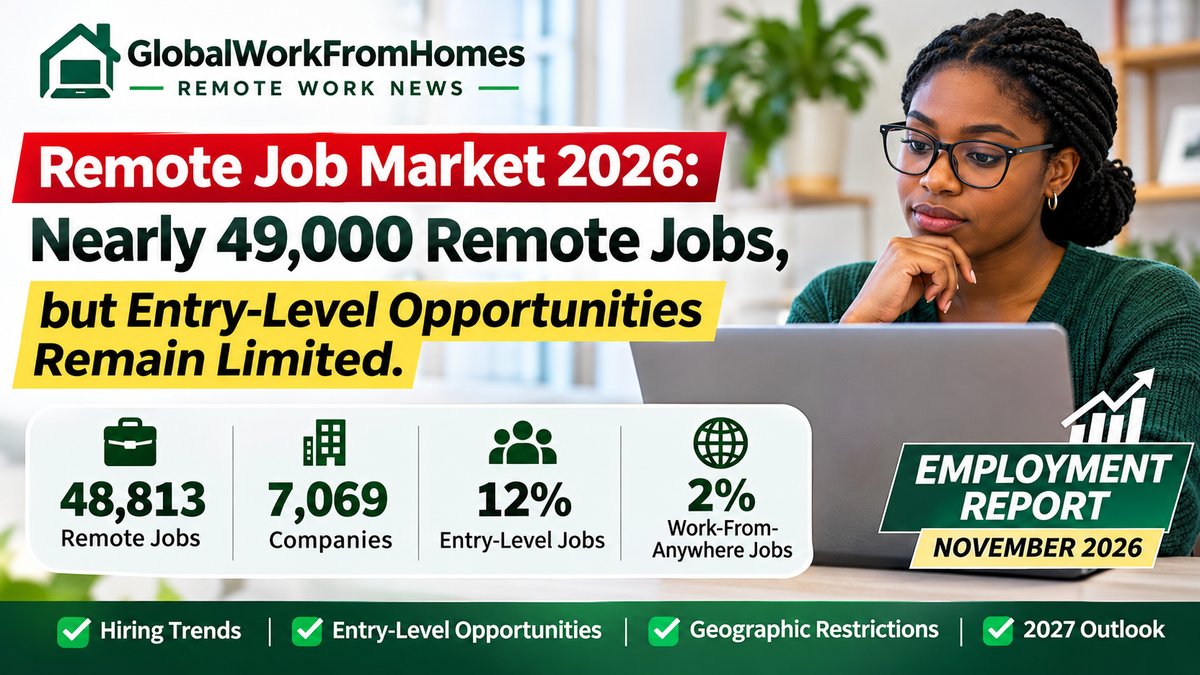
Remote Job Market 2026
Nearly 49,000 remote jobs, but entry-level opportunities remain limited.
The remote job market continues to offer thousands of employment opportunities as 2026 draws to a close. However, finding a suitable work-from-home position remains particularly challenging for people with limited professional experience.
A November 22, 2026, report from remote employment platform Psst identified 48,813 remote job listings across 7,069 companies. Despite the substantial number of opportunities, only 12% qualified as entry-level positions, while approximately 2% offered worldwide employment.
Meanwhile, employment data from Indeed Hiring Lab suggests that the broader U.S. job market is showing signs of improvement. Nevertheless, challenges remain for early-career professionals.
Together, these findings highlight an important distinction. Remote employment remains available, but accessibility depends heavily on experience, professional skills and geographic eligibility.
Source: Psst Remote Jobs Report , November 22, 2026 snapshot. These figures describe the platform’s dataset, not the entire global employment market.
Remote Job Market in November 2026: What the Numbers Reveal
The November 22 remote employment report provides a useful snapshot of opportunities available through company career websites.
In particular, the findings highlight differences in experience requirements, geographic eligibility and the age of advertised vacancies.
| Market Indicator | November 22, 2026 |
|---|---|
| Remote job listings | 48,813 |
| Companies represented | 7,069 |
| Recently posted jobs | 3,833 |
| Entry-level opportunities | 12% |
| Listings explicitly requiring no experience | 161 |
| Work-from-anywhere opportunities | Approximately 2% |
| Listings open for at least 90 days | 35% |
Source: Psst Remote Jobs Report, November 22, 2026.
What the Numbers Mean for Applicants
The figures show that remote employment remains a significant part of online recruitment. Nevertheless, advertised vacancies do not necessarily represent opportunities available to every applicant.
For example, beginners searching for fully remote positions face a narrower selection than experienced professionals.
Similarly, applicants outside approved hiring regions may find themselves ineligible for positions that otherwise match their qualifications.
Entry-Level Remote Jobs Remain Difficult to Find
One of the most important findings concerns access to remote employment for beginners.
Although Psst identified nearly 49,000 remote listings, only 12% fell within its entry-level classification. Furthermore, just 161 advertisements explicitly indicated that applicants needed no previous experience.
Entry-level positions accounted for only 12% of the remote jobs in the November 22 dataset. Therefore, applicants without extensive experience face a smaller selection of opportunities.
Entry-Level Does Not Always Mean No Experience
However, entry-level and no-experience positions are not necessarily the same. Some employers accept applicants with limited experience, relevant training or transferable skills.
Consequently, job seekers should examine the actual responsibilities rather than dismissing every opportunity that requests experience.
For example, someone transitioning from retail, hospitality or administration may already possess valuable customer service and problem-solving skills.
Customer Support and Administrative Roles Offer Entry Points
The distribution of opportunities varies considerably across occupational categories.
For instance, the November report identified higher concentrations of entry-level positions in administrative work and customer support than in technical occupations.
Entry-Level Share by Remote Job Category
Why Occupational Categories Matter
For beginners, these differences matter more than the overall number of advertised vacancies.
An applicant may find thousands of technology positions online. However, many require specialised knowledge or professional experience.
By comparison, customer service and administrative positions may offer more accessible entry points for applicants with transferable skills.
Nevertheless, competition, geographic restrictions and employer-specific requirements can still limit access.
Remote Does Not Always Mean Work From Anywhere
Many job seekers associate remote employment with the freedom to work from any country. However, employers frequently restrict hiring to specific locations.
Psst classified approximately 43% of its remote listings as available only to people living in the United States.
Meanwhile, only around 2% allowed worldwide employment. Consequently, international applicants may face a much smaller selection of vacancies.
Why Employers Restrict Remote Hiring
Employers may impose geographic restrictions for several reasons, including:
- Payroll administration.
- Employment regulations.
- Taxation requirements.
- Data protection obligations.
- Customer coverage and time zones.
- Business operational requirements.
Therefore, job seekers should examine location requirements before investing time in an application.
Furthermore, applicants searching internationally may benefit from using terms such as worldwide remote, international remote or work from anywhere.
However, always confirm eligibility through the employer’s official career website.
Indeed Reports Signs of Improvement in the U.S. Job Market
While remote employment remains competitive, recent figures suggest that the broader U.S. employment market may be gaining some momentum.
According to the November 24, 2026, U.S. Labor Market Snapshot from Indeed Hiring Lab, its Job Postings Index increased by 5.1% compared with the previous year.
In addition, Indeed recorded a 2.3% monthly increase in job postings as of mid-November.
Job Postings Versus Actual Hiring
However, an increase in job advertisements does not necessarily indicate an equivalent increase in completed hires.
For example, employers may take longer to fill positions, retain advertisements while reviewing candidates or exercise caution before making employment decisions.
Furthermore, hiring conditions vary significantly across industries and professional experience levels.
Therefore, the broader recovery offers some encouragement. Nevertheless, these figures do not establish that remote vacancies are increasing at the same rate as overall job advertisements.
Source: Indeed Hiring Lab , November 2026 U.S. labor market data.
Technology Hiring Shows Signs of Recovery
Software development was one of the occupational categories showing improvement in Indeed’s November report.
Specifically, software development job postings increased by 23.4% compared with the previous year.
Although this figure includes employment arrangements beyond remote work, it provides a relevant signal for professionals pursuing technology careers.
What This Means for Technology Beginners
However, applicants should distinguish between growth in demand and accessibility for beginners.
Technical employment often requires practical experience, demonstrable skills and familiarity with industry tools.
Consequently, an increase in advertised positions may primarily benefit applicants who already meet employers’ technical requirements.
Areas worth monitoring include:
- Software development.
- Cloud computing.
- Cybersecurity.
- Information technology support.
- Data analysis and engineering.
- Artificial intelligence and automation.
Nevertheless, the outlook differs by employer and specialisation. Growth in one technology occupation does not guarantee growth across every technical field.
Older Job Listings Present Another Challenge
The number of remote vacancies available online does not tell the entire story.
According to Psst’s November 22 report, 35% of remote listings in its dataset had remained open for at least 90 days.
However, a long-running advertisement does not automatically indicate a fraudulent or inactive vacancy.
For example, some employers recruit continuously, search for specialised candidates or maintain recruitment pipelines.
How Applicants Can Verify Availability
Before applying, job seekers should confirm that the position remains available on the employer’s official career page.
Additionally, applicants should examine whether the company provides a clear job description, identifiable recruitment process and legitimate application channel.
As a result, applicants may avoid spending unnecessary time on outdated advertisements.
What the 2027 Employment Outlook Means for Beginners
A separate report from Indeed and Glassdoor, dated November 18, 2026, highlights challenges that could shape employment conditions in 2027.
The report discusses differences between opportunities for experienced professionals and those attempting to enter the workforce.
Furthermore, it examines changing employee expectations, artificial intelligence adoption and the possibility of increased labor market activity.
Opportunities and Uncertainty
However, these developments represent an outlook rather than a guaranteed forecast.
An improving employment market could create additional opportunities for early-career professionals.
Conversely, economic uncertainty could encourage employers to remain selective.
Therefore, applicants entering 2027 may benefit from developing relevant skills and demonstrating their practical abilities.
What Remote Job Seekers Should Prioritise
The latest employment figures suggest that job seekers may benefit from a more targeted approach to remote employment.
1. Verify Geographic Eligibility
Before preparing an application, confirm that the employer accepts applicants from your country or state.
Consequently, this simple check can prevent unnecessary applications to positions for which you do not qualify.
2. Focus on Relevant Employment Categories
Applicants without extensive professional experience may benefit from exploring customer support, administrative assistance and other occupations with comparatively accessible entry requirements.
However, individual qualifications and professional interests should guide career decisions.
3. Demonstrate Transferable Skills
Previous experience does not need to come from a remote position to be valuable.
For example, communication, organisation, customer service, documentation and problem-solving skills apply across multiple industries.
4. Prioritise Recently Advertised Vacancies
Newly published opportunities may help applicants identify employers with current recruitment needs.
Nevertheless, older listings can remain legitimate. Therefore, verify availability rather than relying exclusively on publication dates.
5. Continue Developing Practical Skills
Professional development remains important, particularly for applicants pursuing technical and specialised remote occupations.
Furthermore, practical projects, relevant courses and demonstrable achievements can provide useful evidence of an applicant’s capabilities.
What GlobalWorkFromHomes Will Be Watching in 2027
The November employment figures raise several important questions about the future of remote work.
- Will entry-level opportunities become more accessible as overall recruitment improves?
- Will employers expand their international hiring policies?
- Will technology hiring create additional opportunities for people entering digital careers?
- Will artificial intelligence create new employment opportunities for remote workers?
However, these questions cannot yet be answered with certainty.
Future employment reports may help determine whether the improvements observed in November develop into a sustained recovery.
Meanwhile, GlobalWorkFromHomes will continue monitoring developments in remote employment, artificial intelligence jobs, technology recruitment and work-from-home opportunities.
Stay Informed About Remote Work
Discover remote employment opportunities, hiring developments and practical career resources from GlobalWorkFromHomes.
Find Remote Jobs Latest Remote Work NewsAbout the Data and Its Limitations
Remote Employment Dataset
The remote employment figures discussed in this article come from Psst’s November 22, 2026, dataset.
Its report draws on publicly available company career pages and uses automated methods to classify remote vacancies, experience requirements and geographic eligibility.
Consequently, these figures represent the platform’s coverage rather than a complete census of global remote employment.
Broader U.S. Employment Data
Indeed Hiring Lab’s November employment report measures the broader U.S. job advertisement market.
Its findings include positions that may require on-site, hybrid or remote work arrangements.
Therefore, the two datasets use different methodologies and should not be treated as directly comparable measures.
Important Research Limitations
Furthermore, advertised job vacancies do not necessarily represent completed hires or guarantee employment availability.
Psst updates its remote employment report regularly. As a result, readers may encounter different figures when visiting the source after November 22, 2026.
Sources and References
- Psst – Remote Jobs Report . November 22, 2026 snapshot.
- Indeed Hiring Lab – U.S. Labor Market Snapshot, November 2026 . November 24, 2026.
- Indeed and Glassdoor – 2027 U.S. Hiring and Worklife Trends Report . November 18, 2026.
Share this: